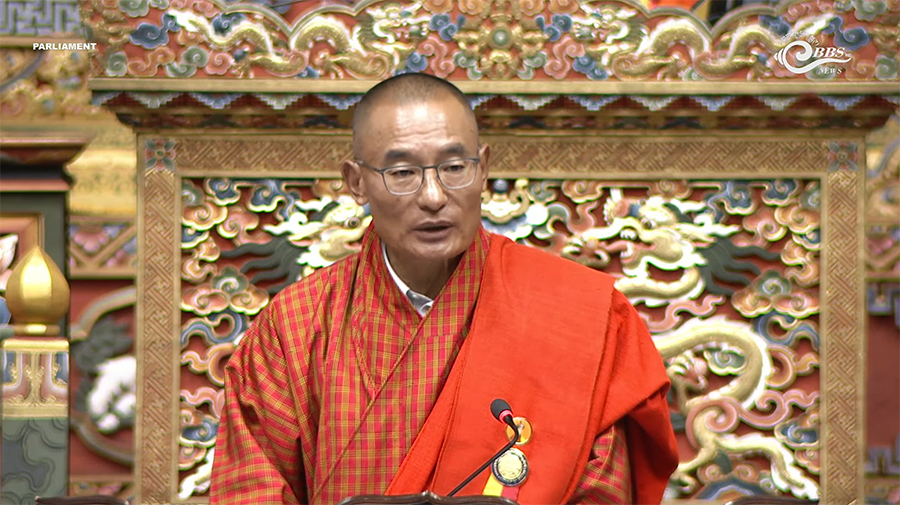
 Bhutan’s Gross Domestic Product has grown by 30 per cent since the start of the 13th Five-Year Plan in July 2024, increasing by Nu 84bn. The Prime Minister shared this while presenting the Annual Report on the State of the Nation today.
The country’s GDP stands at Nu 364bn.
The Prime Minister said key sectors, including energy, agriculture, tourism, manufacturing, cottage and small industries, and other economic initiatives, have driven growth.
Hydropower continues to power the country’s economic growth.
Prime Minister Tshering Tobgay said, “When the 13th Five-Year Plan began, Bhutan’s hydropower capacity stood at 2452 MW and has since increased to 3576 MW. The commissioning of the Punatsangchhu Hydropower Project added 1,020 megawatts of generation capacity. Furthermore, three additional small hydropower projects have also been commissioned. And they are: Yungichhu, Burgangchhu, and Suchhu.”
The government aims to increase Bhutan’s hydropower capacity to 25,000 megawatts by 2040.
Construction has resumed on the Khorlochhu and Punatsangchhu-I hydropower projects, while work has begun on the Wangchhu project. The Prime Minister said the Dorjilung Hydropower Project is also ready to begin.
Meanwhile, Druk Green Power Corporation will develop five additional small hydropower projects alongside projects at Parochhu, Gamri-II, Yurmongchhu and Sherichhu.
The government is also partnering with Tata Power, Adani Power, Jindal, GMR and PTC to develop 11 hydropower projects with a combined capacity of more than 6,800 megawatts.
Turning to agriculture, the Prime Minister said the sector contributes less than 15 per cent of GDP but supports the livelihoods of around 43 per cent of the population. He said the government continues to invest in measures to address the challenges facing farmers.
“Human wildlife conflict is one of the major challenges faced by farmers. Therefore, over the past two years, 290 chain-link fencing projects have been completed, protecting 45,724 acres of farmland and protecting approximately 20,440 households from crop damage by wildlife.”
The Prime Minister also highlighted irrigation projects, distribution of power tillers, and supply of fertilisers to strengthen agricultural productivity and improve livelihoods.
Tourism, which contributes around 15 per cent to GDP, also recorded growth.
The Prime Minister said, “We had more than 70 marketing programmes and activities carried out in India and 13 other countries. 22 such programmes were also conducted within the country. And the effort has started paying off. In 2023, more than 103,000 tourists visited Bhutan. And in 2024, more than 150,000 tourists came. Last year, more than 210,000 tourists visited the country. Looking at the trend, the target of 300,000 tourist arrivals in a year looks achievable.”
The Prime Minister said cottage and small industries contribute only four per cent to Bhutan’s GDP despite being a major economic pillar in many countries. To strengthen the sector, the government has provided 3.3 billion ngultrum in concessional loans and supported more than 142 individuals working in the creative industry.
The mineral sector also recorded growth.
“Over the past two years, mineral production has increased from 7 to 12 metric tonnes, with revenue growing from Nu 4bn to Nu 5.5bn. However, there is no national account of the mineral profile and geographical distribution of the minerals in our country. Therefore, a National Mineral Exploration Project has been initiated to map Bhutan’s mineral wealth comprehensively,” added the Prime Minister.
The Prime Minister added that the government has formulated the 21st Century Economic Roadmap in line with the Royal Command, with the goal of expanding Bhutan’s economy tenfold by the end of the decade.
Devika Pradhan & Sonam Yuden