
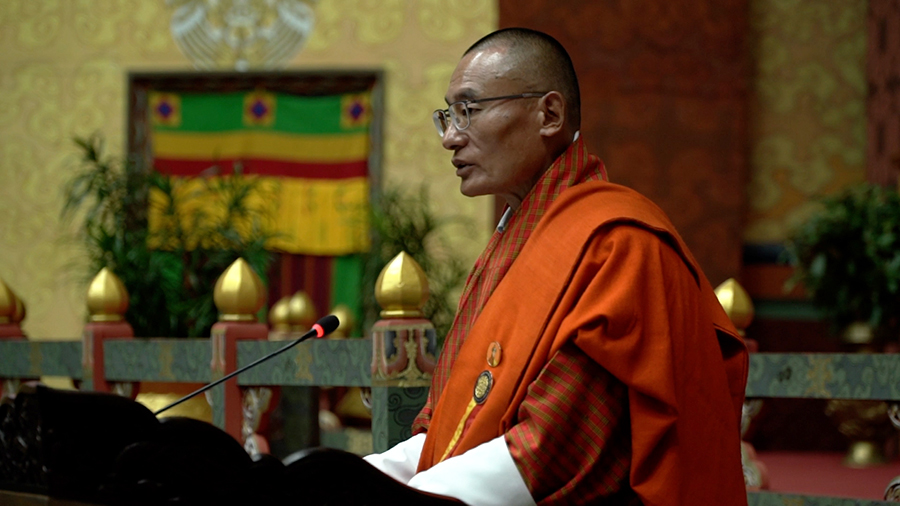
 Presenting the annual State of the Nation Report, the Prime Minister highlighted that Bhutan made significant progress in infrastructure, investment, education, health, and digital transformation during the first two years of the 13th Five-Year Plan. However, youth outmigration and rising fuel prices remain major challenges that could affect the country’s long-term economic growth. The current Plan carries a total budget outlay of Nu 512bn, an increase of around 65 per cent from the previous Plan.
According to the Prime Minister, a major focus during the first two years has been on improving connectivity and laying the infrastructure needed to support growth and make Bhutan a high-income economy by 2034.
Four new national highways have been constructed, eight upgraded, and more road improvement works are planned across the country. The government also expanded rural connectivity through the construction and blacktopping of gewog centre roads.
“Five new bridges have been completed, with nine currently under construction and seven more planned for the next fiscal year. To support the import and export of essential goods, dry ports are critical given our landlocked status. Three dry ports are under construction with an estimated cost of about Nu 4bn. The dry ports in Pasakha and Nganglam have been completed, while the Gelephu dry port is still under construction.”
The government also decided on the development of rail links and domestic airports to improve trade, reduce transportation costs, and strengthen Bhutan’s position as a land-linked economy.
“The Detailed Project Report (DPR) for the Gelephu–Kokrajhar railway has been completed, and construction will begin next year. Similarly, the DPR for the Samtse–Banarhat railway project has also been completed.”
The Prime Minister also highlighted growing investor confidence. Over the past two years, 35 Foreign Direct Investment projects worth around Nu 226bn have been approved. While the government views this as a positive sign for economic diversification and job creation, the success of these investments will ultimately rest on how quickly projects are implemented and how many sustainable jobs are created for the Bhutanese.
Trade expansion has been another priority with the government pursuing a Free Trade Agreement with major partners in the region besides India. Accession to the World Trade Organisation is also progressing.
Despite the positive indicators, the Prime Minister mentioned two pressures on the economy – rising fuel prices and outmigration, which, in the past, he called an existential threat.
“At present, more than 71,000 Bhutanese are working overseas, most of them young, educated, and skilled. In 2025, remittances from abroad amounted to USD 342.94 M, contributing meaningfully to the economy. The second major challenge is rising fuel prices due to the West Asia conflict.”
The figure underlines the report’s central tension. The plan depends on young, skilled Bhutanese to build and staff it, yet they are the very people leaving. According to the World Bank’s recent report, departures through Paro rose from a few hundred a month before the pandemic to several thousand. The Bhutanese community in Australia roughly doubled between 2020 and 2024. Remittances help the balance of payments; what they cannot replace is the workforce.
Much of the government’s answer to this outflow is skilling. Over the past two years, Technical Training Institutes expanded their capacity from 900 to 3,000 trainees. More than 55,000 youth were trained, including 10,500 unemployed youth and around 7,000 in ICT skills. De-suung, Gyalsung, and Pelsung programmes continue to support human capital development.
Education and health sectors also saw growth with improved structures and services. However, health screening data presented in the report suggest a growing burden of non-communicable diseases.
“However, non-communicable disease is fast becoming a concern and screening facilities have been established in all 20 districts. So far, 278,000 Bhutanese have been screened, of whom around 68,400 have been found to have hypertension or diabetes and are receiving treatment.”
Progress has also been made in the digital economy and cultural preservation.
For now, the government claims the first two years will establish a strong foundation for development. Whether it holds will rest on the remaining three years, and whether the plan can deliver quickly enough to give young Bhutanese a reason to stay.
Sonam Yuden/Devika Pradhan
Edited by Sonam Wangdi