
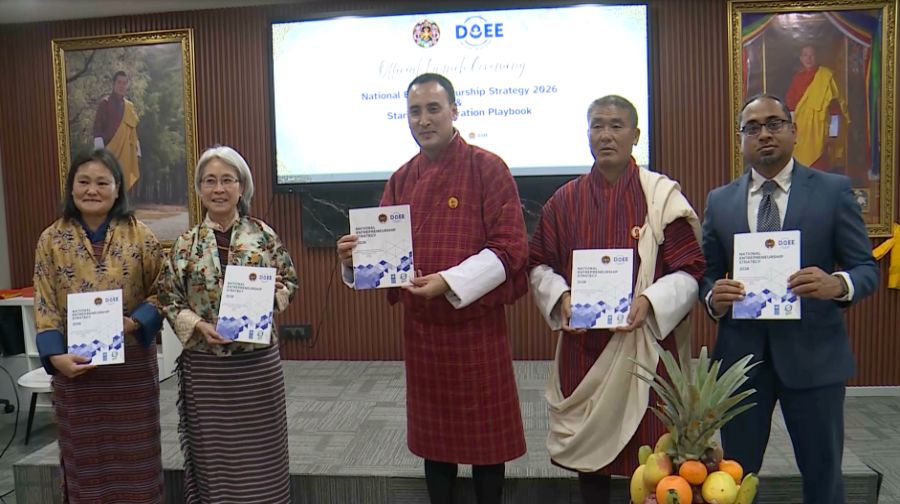
 Starting a business in Bhutan could soon become much easier. The government plans to reduce the time needed to obtain a business licence to within three working days, while improving access to finance and helping local businesses reach international markets. The measures are among six priority areas under the National Entrepreneurship Strategy 2026, launched yesterday.
According to the Ministry of Industry, Commerce and Employment, 96 per cent of businesses are sole proprietorships, while nearly 59 per cent of business licences remain inactive.
Officials say these figures highlight the need for a stronger system that supports businesses to start, survive and grow.
One of the strategy’s key targets is to reduce the time required to obtain a business licence to within three working days.
Until now, securing the necessary approvals, including a Security Clearance Certificate, project approval, and sector-specific clearances, has often taken days before businesses could obtain a licence.
The strategy also addresses access to finance, which is one of the barriers for entrepreneurs. It proposes alternative financing options, such as angel investors and venture capital, to complement traditional bank loans.
To build a stronger entrepreneurial culture, entrepreneurship programmes will be introduced in 90 per cent of schools and colleges, while business support centres will be strengthened to help startups during their early stages.
The strategy also focuses on expanding market access through Brand Bhutan and encouraging businesses to adopt Artificial Intelligence and research-driven innovation to improve competitiveness.
“The Department of Entrepreneurship and Employment has launched an Entrepreneurship Strategy to address structural challenges that the current entrepreneurship ecosystem is facing. They face challenges in terms of regulatory environment, access to finance, entrepreneurship culture and human capital development, support services, market access, research and technology,” said Tashi Tenzin, an assistant programme officer for the Department of Employment and Entrepreneurship, MoICE.
He added that the private sector currently contributes only a small share to the country’s GDP.
Tashi Tenzin said, “The private sector is widely considered the engine of growth in any economy. Even for Bhutan, the private sector is one of the key players in the socio-economic development of the country. The 21st century economic roadmap, 10x vision 2050, says that the private sector should at least contribute 60 to 65 per cent in the overall GDP contribution.”
The strategy also seeks to address broader economic challenges.
More than 20 per cent of Bhutanese youth are unemployed, while around nine per cent of the population has migrated abroad in search of better opportunities.
Officials hope the reforms will encourage more people to start businesses, create jobs and strengthen the private sector’s contribution to the country’s economy.
The Department of Employment and Entrepreneurship will oversee the implementation and monitor the progress of the strategy annually.
“Overall, governance will be looked after by the National Entrepreneurship Council, which will be instituted as a part of the strategy. They will be providing strategic guidance while implementation will be carried out by the DoEE with the relevant implementing partners,” added Tashi Tenzin.
Alongside the strategy, the Startup Acceleration Programme Playbook was also launched to guide future startup acceleration programmes. The playbook will help Bhutanese startups that have already begun operating but need support to grow into successful businesses.
Sangay Chozom
Edited by Sangay Chezom