
 In Bhutan’s private sector, two frustrations often sit side by side. Employers say they cannot find the workers they need, even after advertising a vacancy. Young jobseekers say they cannot find a way in. A recent two-day event, YaY-Gokab, set out to bring those two sides into the same room. It is part of a more deliberate effort by the Department of Employment and Entrepreneurship to connect people to work, and to reach jobseekers it had struggled to reach before.
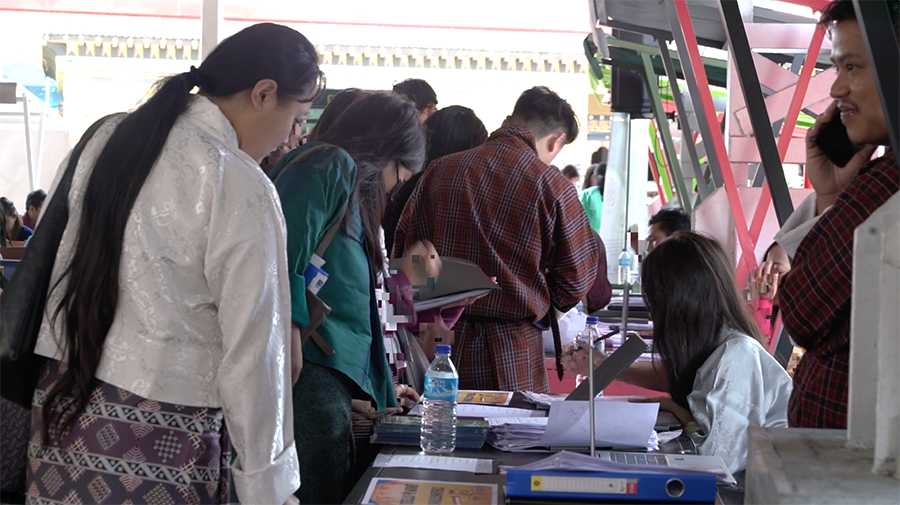 For a fresh graduate, the job market can feel like a closed door. Employers ask for experience, yet experience is the very thing a first job is meant to provide. On the other side of that door, many private companies face the opposite problem: work to be done, and too few hands to do it.
YaY-Gokab was designed to bring those two sides together. And for employers, used to advertising into silence, the chance to meet jobseekers face to face was the real draw.
“Such programmes are very important. In the private sector, we are always short of human resources. But even when we announce a vacancy, it is challenging to find people to work for us,” said Rinchen Dorji, the General Manager of HR and Admin Division with Vajra Builders Private Limited.
But getting the two sides to meet first meant finding the jobseekers. Since May, the department has taken a more deliberate approach, calling registered jobseekers one by one to understand who they are and what they actually need.
Tshering Yangki, Programme Officer with the Department of Employment and Entrepreneurship said, “When we reached out to the registered jobseekers, we found they did not know about the opportunities available, or how to venture into training. That was the gap. They had the potential, but we, as the implementer, had assumed they would know we exist as a department, that they would know we could help them. Instead, it was about shifting that mindset, going closer to them and asking: how should we help you?”
That exercise reshaped how the department works, and it is where an event like YaY-Gokab comes in.
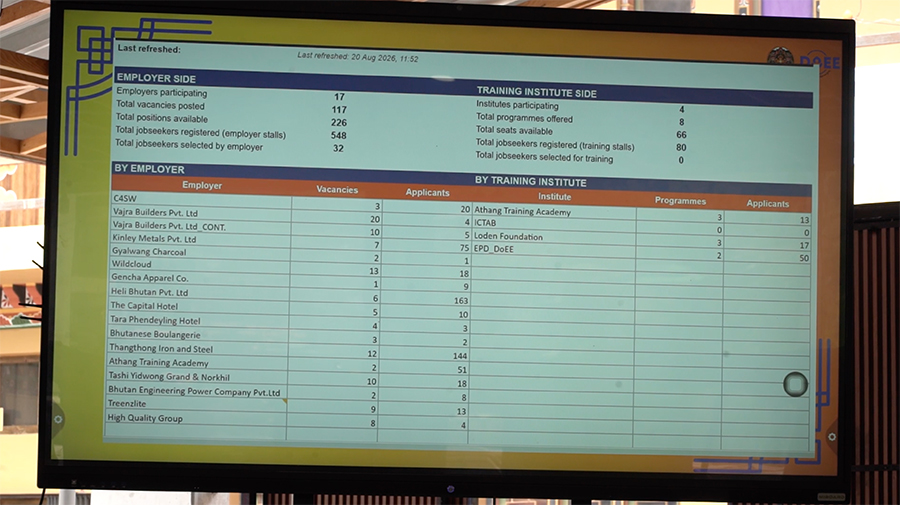 Seventeen private employers and training providers took part, bringing 227 positions between them. More than 400 jobseekers came to meet them, most, the department says, hoping to start work straight away. By the close of the two days, around 35 had been hired on the spot for roles ranging from technicians, plumbers and drivers to jobs in hospitality and administration.
The stakes are highest for the young. While Bhutan’s overall unemployment is low, joblessness among those aged 15 to 24 runs about five times higher. For many at the event, this was a first attempt to break in.
“At first, I thought that as a fresher we won’t get much opportunity; they want everyone to be experienced. So here, it was like, even if you’re not experienced, you can come and interview with us,” said Prena Thapa, a university graduate.
“We did not know where to go or what to do, and this actually gave us so many opportunities, because all the jobs we were looking for were just around us. I also got to learn so many things, like what documents to carry, how confident you have to be when they ask questions, and how you prepare for a job,” added Namgyel Dema Norbu, another graduate.
For employers, the appeal was not only filling today’s vacancies, but building tomorrow’s workforce, even from those without experience.
“We came to employ our young people, and when they come to us, it helps us recruit them. We have also focused on an earn-and-learn scheme, where they can work and learn even if they lack experience,” said Yulkham Geley, the Chairman of Community for Skilled Workers, C4SW.
And the effort does not stop when the stalls come down. For those who left without a job, the department’s employment service centre will provide referrals and track their progress from start to finish. Seventeen have already sought places in training centres.
“We will be extending our partnerships and ensuring these are not one-time support services, but an ecosystem-based approach. So please do not forget — whenever you are in a labour-market dilemma, the department exists to help you. While we extend our hand, we want you to meet us halfway,” added the department’s programme officer, Tshering Yangki.
Not everyone, though, found what they came for.
 Some graduates felt the openings leaned towards technical and trade roles, and a few chose to look at training instead, a quiet reminder that putting the two sides in one room is only half the task. The survey behind the figures points to skills gaps and qualification mismatches as among the leading reasons the young stay out of work. The other half, then, is making sure the opportunities on offer match the people looking for them. For now, by bringing employers and jobseekers together and staying with them afterwards, the department is betting that a narrower gap begins with something simple: getting both sides to meet.
Sonam Yuden
Edited by Sonam Wangdi