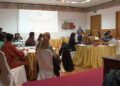
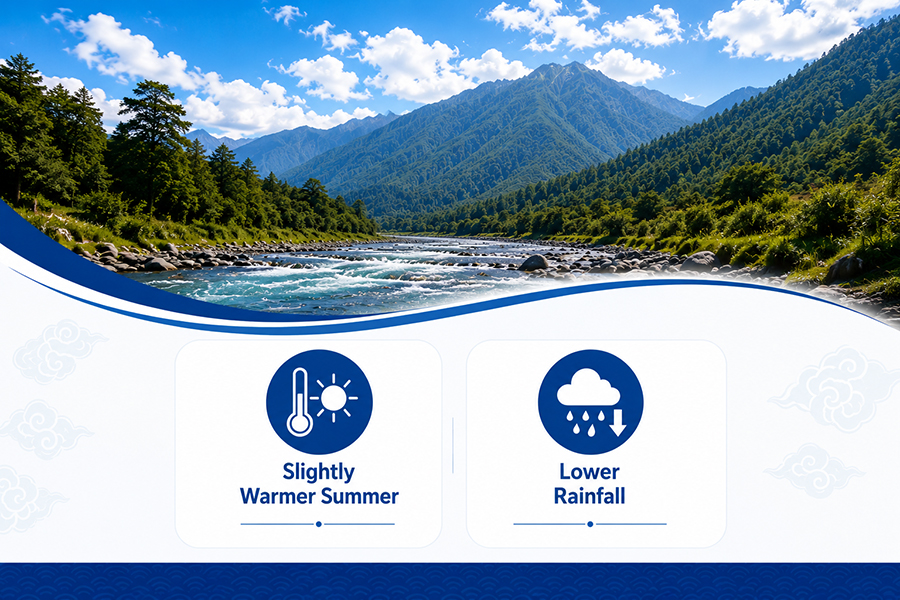
 Bhutan is expected to experience a slightly hotter summer and slightly less rainfall this monsoon. The National Centre for Hydrology and Meteorology has compared this year’s weather forecast with data collected over the past 30 years. The 12th National Climate Outlook Forum presented the forecast today.
The National Centre for Hydrology and Meteorology based its forecast on four sources, including scientific models and global predictions.
According to the centre, Bhutan can expect slightly hotter days and warmer nights during the monsoon season.
The centre’s State of the Climate 2025 report showed that the country’s annual average maximum temperature reached 23.33 Degrees Celsius, while the minimum average temperature stood at 12.84 Degrees Celsius. Phuentshogling recorded the highest daily maximum temperature at 30.15 degrees Celsius last year.
Like last year, the centre forecasts the monsoon to begin in June and end in September. However, it expects slightly lower rainfall this monsoon compared with previous years. The centre explained that the rainfall Bhutan is currently experiencing is pre-monsoon rain.
“The annual monsoon rainfall will be lower, but there are chances of normal rainfall over a day or two, as usual. Therefore, there are still chances of landslides and floods,” said Sangay Tshering, a meteorology officer with NCHM.
Similarly, Pangrizampa’s astrological forecast also points to lighter rain over lower altitudes this year. However, it warns of possible hailstorms, windstorms and sudden heavy rainfall in high-altitude areas during the harvest season.
“According to our astrology, all four elements appear generally favourable this year. However, there is a possibility of more fire-related incidents, which may lead to higher temperatures. In addition, there are chances of heavy rainfall, particularly in the highland areas,” said Phub Dorji, a lecturer from Pangrizampa School of Astrology.
The astrological forecast is based on Datho, a traditional guide used by astrologers.
Meanwhile, the general public is advised to follow the weather advisories issued by the centre.
Kelzang Chhophyel & Namgay Wangdi
Edited by Sangay Chezom