
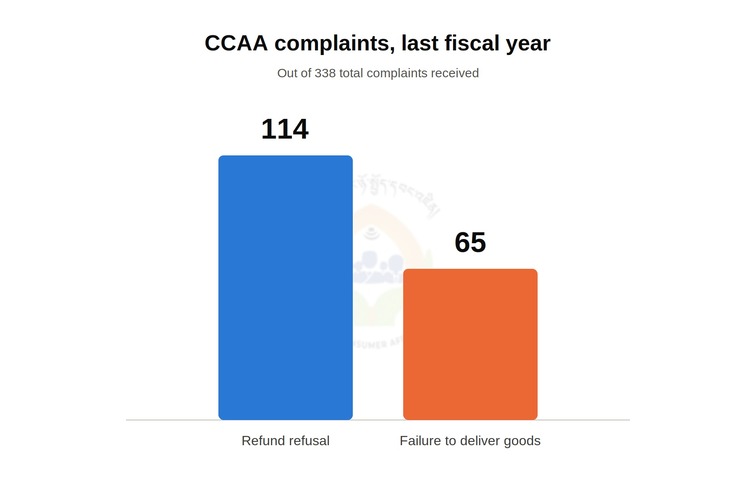
 Paying for something and getting nothing in return, or being refused your money back when a purchase goes wrong. These were the two most common grievances Bhutanese consumers reported last fiscal year. As per the Competition and Consumer Affairs Authority’s (CCAA) latest Grievance Redressal and Market Surveillance Report, these two together accounted for more than half of all complaints received.
Every purchase comes with an expectation: a product delivered on time, a service that meets standards, and a seller who stands behind what is promised.
But for hundreds of consumers last fiscal year, those expectations were not met. Of the 338 complaints the CCAA received last fiscal year, 114 were refund refusal and 65 were failures to deliver goods.
The Authority received the grievances through its complaint management system, walk-ins, toll-free services, and email.
Beyond refunds and non-delivery, consumers also reported defective products, pricing disputes, misleading claims, and warranty non-compliance.
As per the report, except for four, all other cases were resolved. The unresolved cases are under investigation due to incomplete information or non-response from the parties involved.
For those who spoke up, complaints led to action. Through intervention and mediation, the authority facilitated refunds amounting to Nu 2.78 M. Compared to the 2024-25 fiscal year, this is a reduction of almost 50 per cent.
Meanwhile, non-compliant businesses paid penalties amounting to a little over Nu 70,000. The figure, smaller than the refunds, indicates that the Authority’s approach still leans towards mediation and restitution rather than punishment.
Two complex cases went a step further. The CCAA referred them to the Dispute Settlement Committee, an independent body established under the Consumer Protection Act 2012. Both involved authorised vehicle dealers in the country.
In one case, buyers of a particular vehicle model reported a recurring defect in the exterior finish, which the Committee recognised as a manufacturing defect. The dealer was directed to carry out one-time repairs on all affected vehicles for free. In the other, a faulty component in a vehicle led the Committee to direct the dealer to replace the part, cover servicing costs, and honour the extended warranty.
The authority says the findings show a continued need to strengthen consumer awareness and business compliance.
Looking ahead, it plans to expand enforcement, strengthen coordination with other agencies, and increase the use of technology-based monitoring systems as Bhutan moves towards an expanded consumer protection and competition framework.
Tashi Dekar
Edited by Sonam Wangdi