 Nearly 80 per cent of the districts in the country now offer palliative care services, bringing medical support and pain relief closer to patients with life-threatening illnesses. The health ministry is expanding the programme to reach every district by October, allowing more patients to receive care and spend their final days with comfort and dignity at home.
Every morning, except Sundays, an ambulance carrying the palliative care team sets out to a patient’s home in Thimphu.
Their destination is not an emergency scene but the homes of patients who are too ill to travel. The team provides home-based palliative care, helping patients manage pain and improve their quality of life while also supporting their families.
On one such visit, the team attends to a 19-year-old patient diagnosed with advanced osteosarcoma, a rare bone cancer that primarily affects adolescents.
She has been bedridden since February, when her family finally learned the cause of her illness after months of searching for answers.
“We took her to Monggar hospital at least three times, and they said she had no disease. We took her to Lungtenphu hospital about two or three times, and they said she had no disease. Later, Monggar hospital said she had cancer and told us to take her to the hospital. In Kolkata, they said it was bone cancer, and it’s too late, and there was no treatment. They told us to return,” said Tshering Dema, a caregiver.
Her mother and sister watch closely as the team demonstrates how to manage her pain and administer medication, allowing them to continue caring for her between visits.
Tshering Dema, a caregiver says, “Even washing her hands causes her pain. The doctors and nurses visit us regularly, and when her medicines run out or she becomes very sick, they come immediately. They have helped us in so many ways.”
The family left their home in Trashi Yangtse and now rents a house so their daughter can receive the care she needs.
Similarly, across town, another family is also relying on the service.
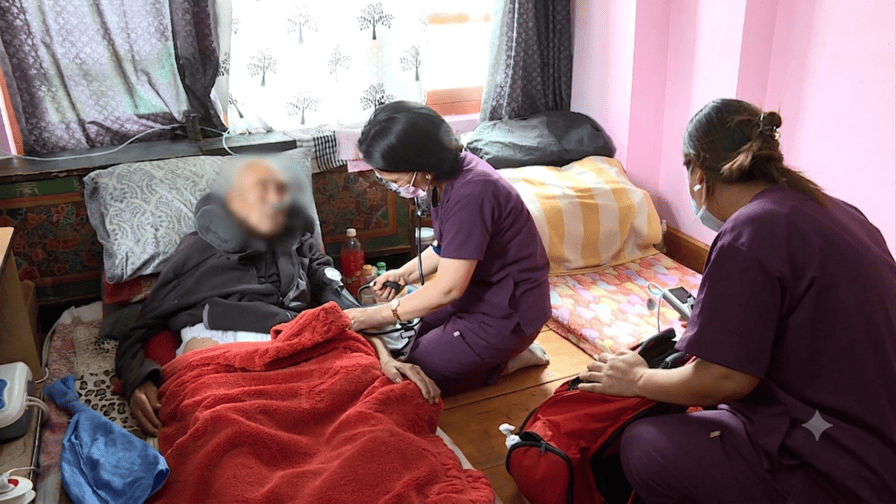
88-year-old man was recently diagnosed with head and neck cancer. Travelling to the hospital has become increasingly difficult, making home visits a lifeline for both him and his family.
“This service is incredibly helpful for us. Many elderly patients have difficulty moving because they are weak and in pain. However, when the team comes to our house, it eases both the patient’s suffering and makes our work easier,” said Choki Dema, also a caregiver.
These families are among more than 1,100 patients receiving home-based palliative care across the country. Palliative care focuses on relieving pain and managing the physical, psychological and spiritual challenges faced by people living with life-threatening illnesses and their families.
“In our unit in home care, we have almost 89 per cent consisting of cancer patients, and we do have a small portion of heart, like end-stage heart patients, end-stage renal patients, end-stage respiratory, and also some neurological patients, like very advanced Parkinson’s or advanced dementia,” said Dr Kinley Bhuti, Palliative Care Physician, JDWNRH.
According to the National Referral Hospital, patients are referred through an established nationwide system. The country currently has only one working palliative care physician.
“We have well-structured referral pathways now that we have incorporated in our unit. We received most of our patients from the oncosurgeons, the head and neck oncosurgeons, the gyno-oncosurgeons, and the GI oncosurgeons, and we also received many patients directly from India who were actually referred for treatment there, and then they are no longer receiving treatment, so they were referred back,” said Dr Kinley Bhuti, Palliative Care Physician, JDWNRH.
“Once the patient gets registered with a relative care, we do home visits. Our home visits are from Monday to Saturday, so we do home visits from 9 AM to 3 PM, where we look after symptom management at home,” said Denkar, Palliative Care Nurse, JDWNRH.
To expand access beyond the capital, the health ministry has trained multidisciplinary teams, including public health officials, doctors, clinical or staff nurses, health assistants, pharmacists, physiotherapists, and traditional medicine staff.
Palliative care services are now available in 15 of the country’s 20 districts, and the ministry aims to achieve nationwide coverage by the end of October.
However, the shortage of trained doctors and nurses, along with funding constraints, continues to pose challenges to expanding the service.
Since the programme began, over 900 patients receiving palliative care have died, most of them peacefully in their own homes, surrounded by their loved ones.
As the service continues to expand, it is a step towards ensuring what the World Health Organisation recognises as a fundamental human right: access to palliative care for all.
Singye Dema
Edited by Sonam Pem