Bhutan is among the few countries globally that absorb more carbon than it releases. The Constitution mandates that most of its land stay forested for all time. Now, after its first nationwide survey, Bhutan knows there may be copper, tungsten, and other metals beneath that forest. While the Department of Geology and Mines (DGM) undertakes the survey’s ground validations, this possibility raises a policy question. Can a nation that built its name on conservation also become a mining country?
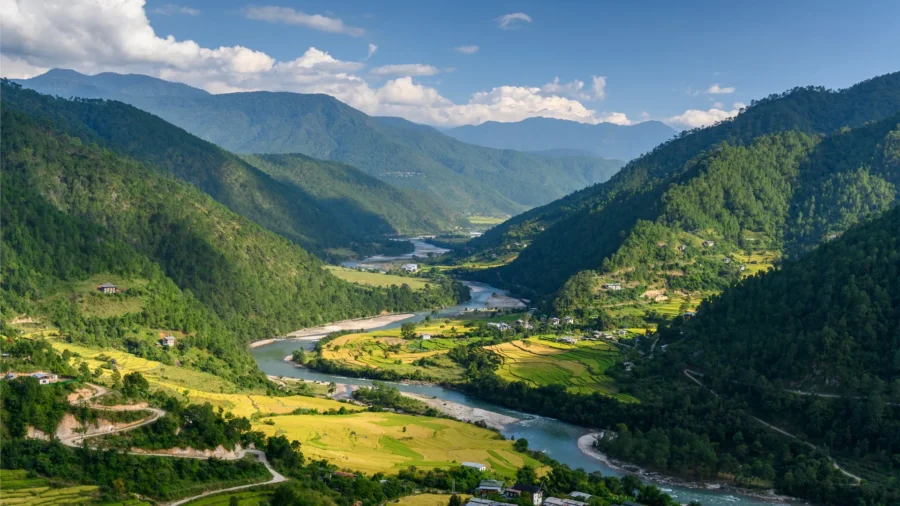
Bhutan’s green record is not a slogan. The Constitution requires at least 60 per cent of the country to stay under forest cover. Today, it is around 72 per cent. The country emits roughly one-and-a-half million tonnes of carbon a year, and its forests soak up more than six million.
Conservation is not an add-on here. It is one of the four pillars of Gross National Happiness, the philosophy every government policy is measured against.
Mining sits uneasily beside all of that.
According to the Department of Geology and Mines (DGM), currently, mining permits require binding environmental, forestry and cultural clearances. Mining is barred inside protected areas. Operators must lodge an Environmental Restoration Bond before they begin. Besides restoration, the DGM’s Director General, Phuntsho Namgyal, says it has to happen during a mine’s life and not left to the end.
“The Department, or the regulator, holds the authority to suspend or terminate mining leases for non-compliance with these restoration requirements, or any other permit conditions.”
On whether Bhutan is even equipped for mining the recently indicated minerals, the Director General was candid. Bhutan has a mature industrial-mineral sector – dolomite, gypsum, limestone. But it lacks the infrastructure to mine metals like copper and tungsten. He says the country is prepared to form strategic partnerships to build that expertise, and points to the airborne survey itself as proof the Department can run complex work.
However, he drew one line clearly.
“Establishing what a country holds is not a decision to extract it. Any future development will be strictly contingent upon the national need, public consensus, and full compliance with our constitutional commitments, and GNH.”
But if the country ever mines, how far?
The Director General frames it as “mindful mining.” Extraction that is surgical, precise, and contained. He points to precision underground mining, instead of large open pits, to spare forest and reduce erosion on steep slopes, and to dry processing and dry-stack tailings, to cut down on water.
“Bhutan does not view mining technology through the lens of maximising volume, but through the lens of mindful mining.”
Currently, Bhutan’s mines use open-pit extraction, with real impact on land, water and wildlife.
According to studies, moving from large open pits toward precision or selective underground mining sharply cuts surface disruption, which matters most on fragile, steep terrain. It also spares forest and lowers erosion and slope-failure risk. Satellite and remote-sensing data now help planners minimise the initial disturbance by targeting only where the minerals are, and buffer zones are maintained around sites to allow wildlife movement. Electrified and hybrid haul fleets and equipment produce no tailpipe emissions, improving air quality. On-site renewables can power operations.
Meanwhile, the Prime Minister, Tshering Tobgay, said that frameworks and policies are already in place to ensure Bhutan’s sustainable mining practices.
“We will not deviate from the principles of GNH, which is our development paradigm.”
He added that the nation’s people and the environment will always be at the forefront of any development initiatives.
The position of the government and the DGM is clear: mine only if the nation needs it and with methods designed to touch the land as lightly as possible.
Whether that is a genuine balance, or a harder compromise than it sounds, may come down to something no survey can measure. It is not what lies beneath Bhutan, but how faithfully the rules are followed once the digging begins.
For now, Bhutan has chosen to know what it holds.
Sonam Wangdi