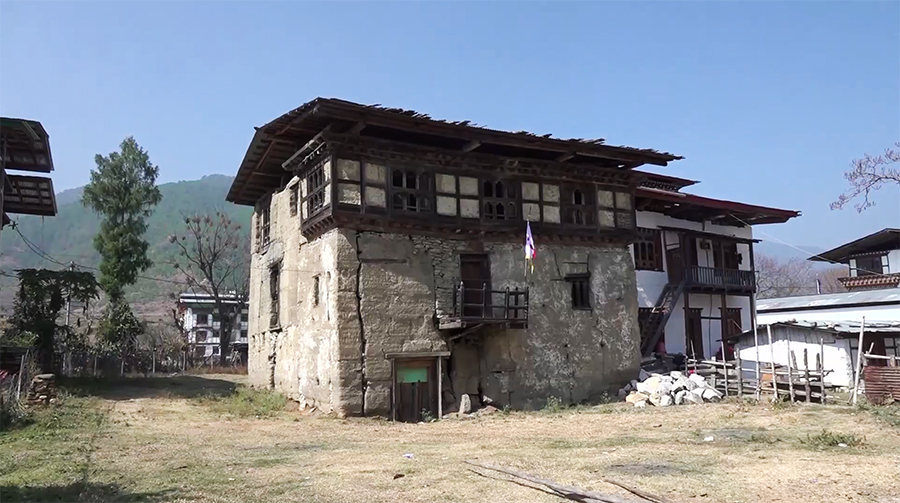
 For centuries, the house of Changyul Bum Galem in Punakha has stood as a symbol of history, culture, and tradition. However, today, the structure is fighting a battle against time. Deep cracks now run across its walls, and residents fear that the recent earthquake has pushed the historic house closer to collapse. Concerned neighbours and the owner are once again appealing for an urgent intervention before a treasured piece of Bhutanese heritage is lost forever.
The three-storeyed rammed-earth house at Changyul is believed to be more than four centuries old.
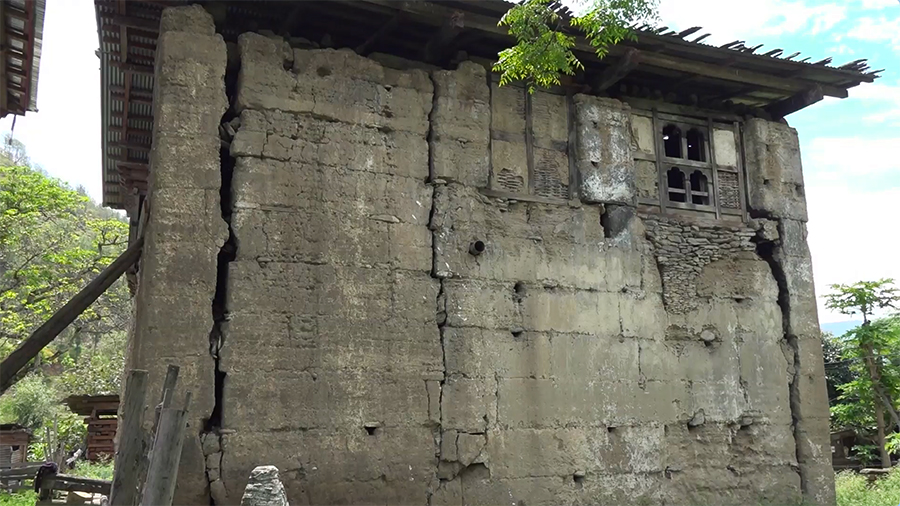 Large vertical and horizontal cracks cut across its walls. Chunks of plaster have fallen away, exposing the inner layers of the ancient structure. Near the corners and foundation, sections of the walls appear weakened and eroded, raising serious concerns about the building’s stability.
The signs of deterioration are not limited to the walls.
The wooden windows and frames have weathered decades of sun and rain. Some panels hang loosely, while the timber shows visible signs of decay. The doors and balcony appear equally fragile, reflecting years of exposure and wear.
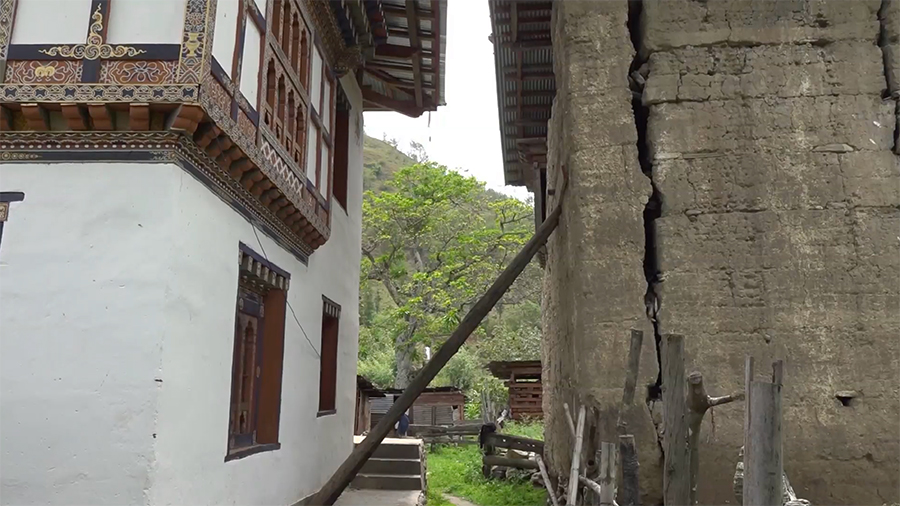 Fearing the worst, residents have erected wooden supports against parts of the structure in an attempt to prevent a collapse. The surrounding area has also been fenced off to keep visitors away due to the critical condition of the structure.
Concerned about a possible collapse, residents have installed temporary wooden supports and fenced off the surrounding area to protect visitors and nearby homes.
Amid growing concerns, the recent earthquake further aggravated the damage.
Residents say several existing cracks widened noticeably after the tremor, particularly on both sides of the house. What was once a concern has now become an urgent threat.
One of the neighbours living few metres away said she constantly worries about the safety of her family. Moments after the earthquake struck, she rushed outside to inspect the old house and discovered that the damage had worsened.
“My only concern is that if Galem’s house collapses, it could hit my house. It is certain that my house would be damaged. Everybody knows about the situation. There is only a little distance between my house and the old structure. This earthquake has further aggravated its condition. I am sure the structure would definitely collapse if a similar earthquake strikes again,” said Chimi Dem, a resident of Changyul_Lungsigang_Tashijong, Guma Gewog.
She is planning to submit a letter to the district administration about the risk.
Yet despite the growing risk, restoration work remains stalled.
Because of its cultural and historical significance, the Department of Culture and Dzongkha Development has restricted renovation by the house owner. Renovation can only proceed through an approved restoration project, which remains dependent on funding.
Meanwhile, the owner continues to wait anxiously.
House Owner Namgay Zam said, “We were told that the house would be renovated around last year, but that has not happened. The condition of the house worsened last year compared to the previous year, and it is deteriorating even more this year. Moreover, people living nearby say that we will be held responsible if they or their children are injured or killed by falling walls during an earthquake. Therefore, we are extremely worried.”
Today, no one lives in the historic house.
For safety reasons, the owners have moved elsewhere, while visitors are kept at a distance by fencing surrounding the site.
Yet even in its abandoned state, the structure continues to attract attention from people eager to see the house.
BBS contacted the district administration over the phone, but they said they do not have any comments on the matter.
The Department of Culture stated that the restoration project is being implemented by the Punakha District Administration.
According to the department, funding worth 130,000 euros had been committed by Pro Bhutan Germany. The district administration tendered the work during the 2024–2025 financial year, but costs exceeded the available budget.
“Two contractors initially quoted more than Nu 20 M for the project, while the available funding from Pro Bhutan Germany was only Nu 11 M. The district negotiated with one contractor, but the price could only be reduced to Nu 19 M. We then consulted the Department of Culture and engaged a third contractor, who agreed to carry out the work for around Nu 14 M.”” said Dendup Tshewang, the officiating chief for the Heritage Sites and Archaeology Division, DCDD.
He added that the district agreed to shoulder the additional costs. However, a series of funding and administrative challenges delayed the project.
“By the time we had finalised the contractor and agreed on the working modalities, we were informed that the German government’s financial year closes in December. As a result, we had to wait for the next financial year before the funds could be released and the restoration work could begin. However, when the new financial year started, we were informed that the funding criteria had changed, and we had to submit a fresh application with revised documents.”
For now, the Department of Culture, in consultation with the district administration, is working on submitting a new revised proposal.
Just as Changyul Bum Galem once waited for Gasa Lamai Singye, her ancestral house now waits for the support needed to save it.
Changa Dorji & Devika Pradhan
Edited by Tshering Zam