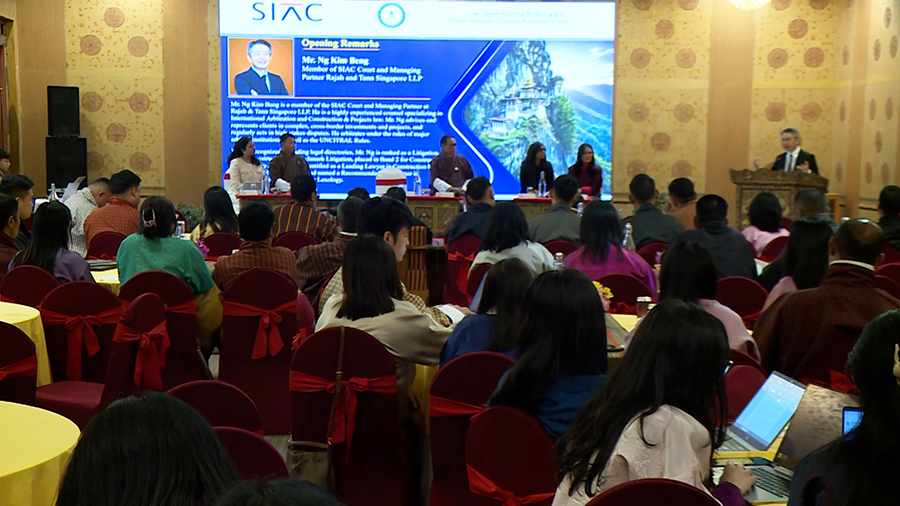
 Arbitration, used as an alternative to court proceedings, can settle disputes faster than the courts. But in the country, it remains underused, mainly because many people are still either unfamiliar or unaware. To address this, experts suggest strengthening judicial support for arbitration, better enforcement of arbitration agreements, and improving infrastructure and accessibility, among others. This was shared during the Bhutan Alternative Dispute Resolution Centre’s conference held in collaboration with the Singapore International Arbitration Centre today.
Arbitration allows two parties to settle a dispute without going to court. Instead of a judge, both parties agree to a neutral arbitrator who hears the case and delivers a binding decision.
Despite the advantages, many continue to rely on courts. One reason is the option to appeal court decisions.
Since its establishment in 2018, the Bhutan Alternative Dispute Resolution Centre has handled just 315 cases to date.
“I think people are unaware of how much autonomy they actually have in arbitration. They can choose their own arbitrator and decide who will hear their case. Secondly, many do not understand the flexibility of the procedure. Going into an arbitration room can feel more intimidating than going to court because it does not follow the same formal procedures. So I think people are not fully aware of these advantages,” said Kunzang Tshomo Dukpa, Managing Partner & Founder, Bhutanese Legal Solutions.
International experts highlighted that stronger support from the judiciary is also important.
“The judiciary should strongly support arbitration by adopting a position of minimal court intervention, upholding arbitration agreements, and ensuring parties are referred to arbitration where applicable. Another international best practice is for the government to provide the necessary infrastructure to encourage arbitration in Bhutan. This is not only about physical facilities, but also improving travel arrangements and overall access to the country for those choosing to arbitrate here,” said Ng Kim Beng, Member, SIAC Court of Arbitration.
Additionally, experts stress the need to better train legal professionals, particularly on drafting clear arbitration clauses. They say this can improve efficiency, reduce delays, and make the process more effective.
Meanwhile, officials from the Bhutan Alternative Dispute Resolution Centre say the conference will help build the capacity of Bhutanese arbitrators.
“As you know, SIAC is one of the leading international arbitration centres in the world and among the top in this region. They bring significant expertise in administering international cases. Collaborating with them will help transfer knowledge and strengthen our systems. It will also allow our domestic arbitrators to learn from their experience and build connections, enhancing both visibility and credibility nationally and internationally,” said Tenzin, Secretary General, Bhutan Alternative Dispute Resolution Centre.
The conference brought together more than 140 participants, including judges, lawyers, corporate counsel, government legal officers, and faculty and students from the Jigme Singye Wangchuck School of Law.
Sonam Yuden & Tashi Dekar
Edited by Sonam Pem