
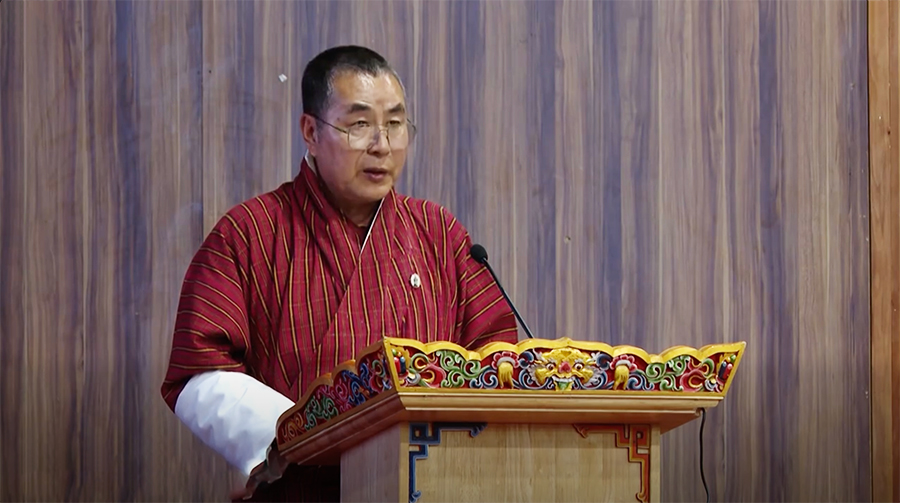
 Bhutan joined the global community in observing the International Day Against Drug Abuse and Illicit Trafficking yesterday, renewing its call for collective action to address drug abuse and protect young people from addiction. The programme was held under the global theme, “World Drug Problem: Persisting Issues, New Challenges, Innovative Responses.”
Addressing the gathering in Thimphu, Health Minister Tandin Wangchuk said drug threats are evolving, with the rise of synthetic drugs, new psychoactive substances and more sophisticated trafficking methods. He called for stronger and more innovative responses.
“Our responses must evolve, and they must keep pace. We must reduce the supply of illicit drugs by strengthening enforcement and taking firm action against trafficking.”
The Health Minister said prevention, education, and awareness are equally important, adding that prevention must start at home, in schools and in communities. He added that people struggling with substance use should receive care, treatment and support for recovery instead of stigma.
The Health Minister said, “No single agency and no government on its own can overcome this challenge. It takes all of us, our health professionals, our partner agencies, civil society, educational institutions, religious bodies, parents and our youth themselves.”
As part of the observance, the Film Association of Bhutan premiered Genkhu, a film developed under the guidance of the National Drug Task Force to raise awareness on drug abuse and recovery. The government provided about Nu 4.5 M for its production.
Similarly, Phuentshogling marked the day through a sensitisation programme.
As the country’s main commercial hub and international gateway, the border town is considered the primary entry point for illicit drugs, making the fight against drugs a critical priority.
“We are carrying out various initiatives to stop the entry of drugs into the country. We are collaborating with our counterparts. We pass them information, and they cooperate with us. They are also working hard with us. We also have informers and are seeking public support,” said Lt Colonel Yeshey Lhendup, Narcotics, Drugs and Other Vices Division, RBP.
He said they are also helping the addicts through the Youth Adoption Programme, where each police personnel adopts and takes care of a recovering addict.
Officials from the relevant agencies also emphasised the importance of developing innovative responses.
“To minimise drug issues, we have to collaborate and support each other. So, for this, we need a recovery community group, as in other countries. We have to support and encourage the recovering addicts. We should not stigmatise them. Similarly, reintegration programmes are also very important,” said Bhup Dhoj Ghalley, the founder and project director of Happiness Centre, Phuentshogling.
Towards the evening yesterday, officials and volunteers from the relevant agencies also carried out sensitisation programmes at the pedestrian terminal.
Karma Wangdi & Kinley Dem