
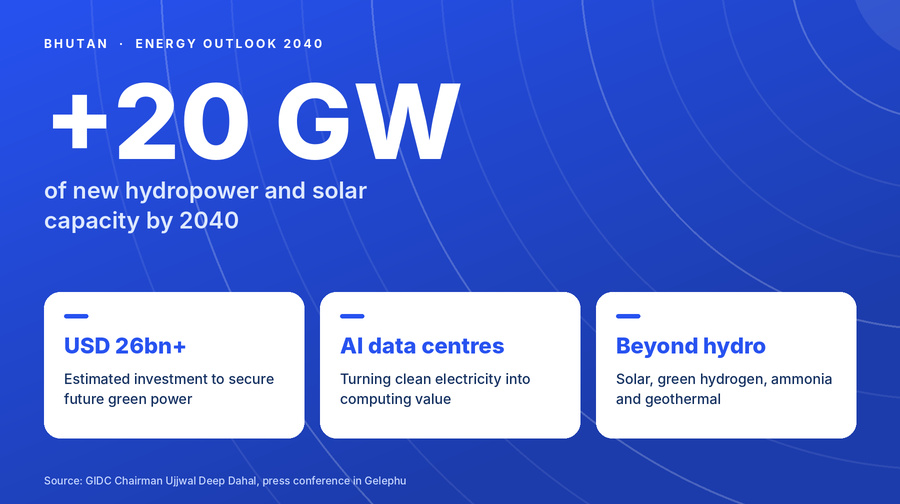
 Bhutan plans to develop an additional 20 gigawatts of hydropower and solar energy by 2040, with investments estimated at more than USD 26bn. The country also hopes to use its renewable energy resources to attract energy-intensive industries, including AI data centres, and generate greater economic value.
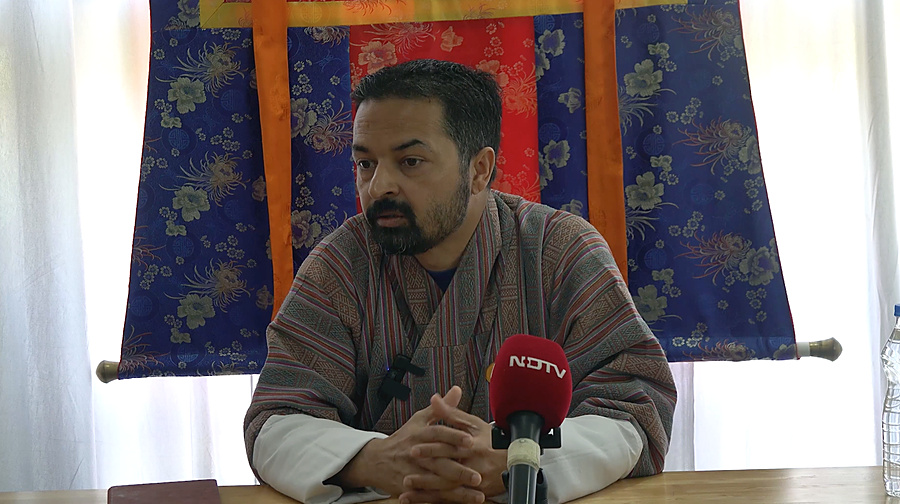
The plan was shared by Ujjwal Deep Dahal, Chairman of Gelephu Investment Development Corporation, at a press conference in Gelephu recently.
Hydropower has long been the backbone of Bhutan’s economy. However, with electricity demand growing and new industries emerging, the country is looking to expand its energy capacity and explore new ways of using its electricity.
The additional 20 gigawatts of hydropower and solar capacity is a national ambition being pursued by Druk Green Power Corporation, a subsidiary of Druk Holding and Investments (DHI).
“If you look at 20 gigawatts of hydropower and solar energy, we are talking about an investment of more than USD 26bn. And that is just to secure the future of green energy and hydropower,” said Ujjwal Deep Dahal.
The expansion is expected to include not only hydropower but also solar energy and other emerging energy sources.
Beyond generating electricity, Bhutan wants to attract industries that require large amounts of power, particularly artificial intelligence and computing infrastructure.
AI data centres require a substantial and reliable supply of electricity. By attracting data centre investors, Bhutan hopes to use its renewable energy within the country and generate more value through computing rather than relying mainly on electricity exports.
The Chairman said the country is working with partners in India, the region and beyond to attract data centre investments and develop what he described as a “compute economy”.
Gelephu Mindfulness City is expected to play an important role in this ambition by attracting international investment, new technology and industries.
Alongside hydropower and solar, Bhutan is also exploring other energy sources, including green hydrogen, ammonia and geothermal energy, to diversify its energy portfolio and meet future demand.
Ujjwal Deep Dahal said GIDC would invest in hydropower with support from DHI and Druk Green Power Corporation. The corporation is also exploring the possibility of producing hydrogen and ammonia, given the demand for these products in markets such as India and Japan.
He said geothermal energy is another area being explored through partnerships involving DHI and GIDC, with support from Gelephu Mindfulness City Authority.
As Gelephu Mindfulness City takes shape, energy is expected to be one of the key foundations for attracting new industries and supporting the country’s economic ambitions.
Tashi Dekar
Edited by Sonam Pem