
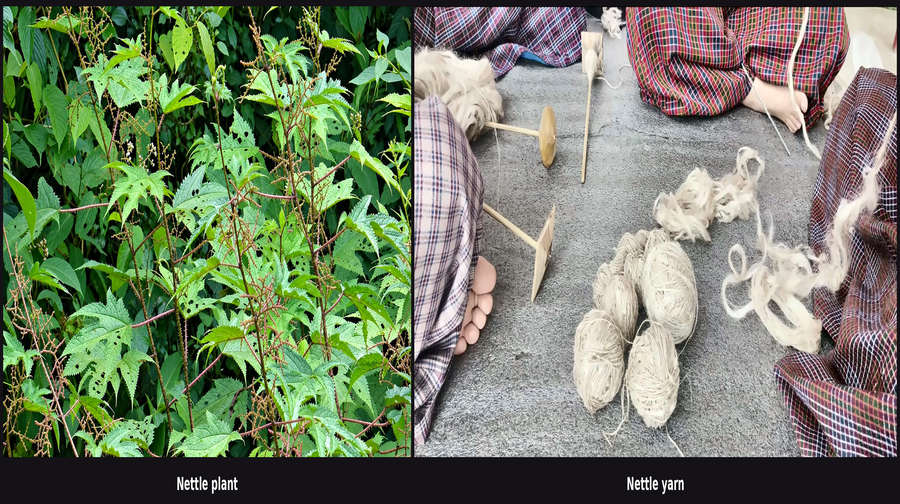
 For survivors of domestic and gender-based violence, rebuilding their lives can also mean finding ways to earn a living and regain financial independence. In Dagana, a week-long training on nettle yarn production is allowing survivors to learn a skill that uses a resource found abundantly in their communities. The initiative by RENEW Community Centre hopes the skill can eventually become a source of income for participants.
For the women, the training is about more than learning how to make yarn. It is about learning a skill they can potentially take home and turn into an income.

Participants from four gewogs in Dagana are learning how to extract fibre from nettle plants and process and spin it into yarn.
For them, one of the biggest advantages is that raw material is already available in their communities.
“Most families in the communities face economic challenges, particularly when there is domestic violence. Women are especially affected economically. Through this training, we hope to improve and strengthen the livelihoods of women. I have a small business, but I cannot rely entirely on it because there are fewer customers,” said Pema Choden, a participant.
“These days, there are more training opportunities and programmes for youths and women. We need to make the best use of these opportunities to supplement our family’s income and household expenses. I found that the training was very beneficial,” said Geeta Gurung, another participant.
A resource person from Trongsa, with more than two decades of experience extracting nettle fibre and weaving Bhutanese textiles, is training the participants. From preparing the raw fibre to producing yarn, participants received hands-on training through the process.
“In my community, people depend on nettle yarn for their livelihoods. We don’t have many income-generating opportunities. But there is a good scope for income generation here since they don’t have to buy nettle plants,” said Dechen, Resource Person.
The plan does not end with the training. The RENEW Community Centre is forming a group to continue producing nettle yarn.
It also plans to provide advanced training so the group can turn the yarn into finished products. The aim is to move from learning a skill to creating a sustainable livelihood.
“I found out there was a lot of market for nettle yarn. And then the price of nettle yarn is also very attractive to the participants so that they can earn after the training,” said Pujan Rai, Manager, RENEW Community Centre, Dagana.
For these participants, a skill that grows from a plant found in their own communities could become a small but meaningful step towards earning, rebuilding confidence and creating a more secure future.
Pema Tshewang, Dagana
Edited by Sonam Pem