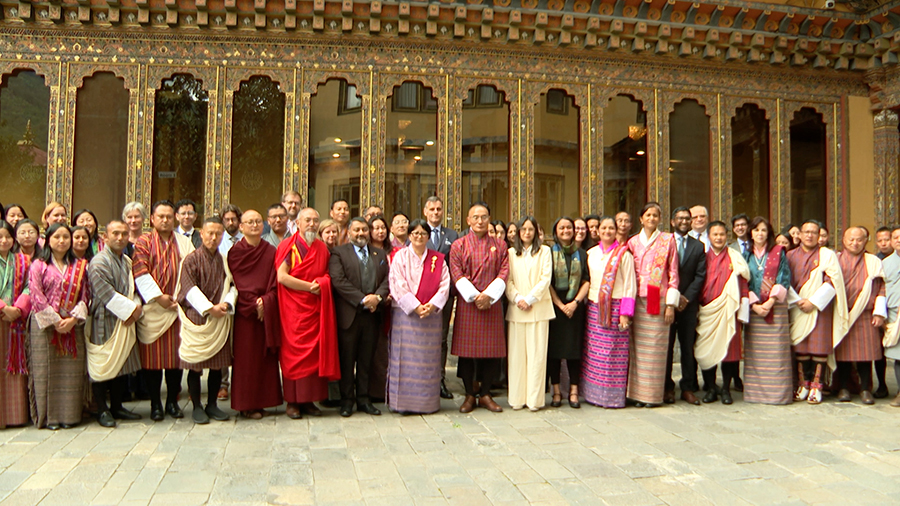
 Bhutan’s Gross National Happiness framework could gain a wider international role as the United Nations and other countries search for better ways to measure development beyond economic growth alone. A workshop in Thimphu explored the creation of an international alliance that would use research and policy cooperation to place people’s well-being alongside conventional economic indicators such as Gross Domestic Product, or GDP.
The five-day workshop explored the feasibility of creating a global alliance to advance well-being-centred governance through research, policy, and collaboration.
Discussions focused on shaping the post-2030 global sustainability agenda, with well-being as a possible foundation for the next generation of Sustainable Development Goals.
Today, the international discussion is already moving towards broader measures of progress. In September 2024, UN member states adopted the Pact for the Future, committing to develop measures that complement or go beyond GDP.
In May this year, a UN high-level expert group proposed a global dashboard covering human well-being, social and economic inclusion, and environmental sustainability.
The Vice-Rector of the United Nations University said Bhutan could contribute to this emerging international debate.
“GNH is a very inspiring initiative worldwide because the Bhutanese government is the only government which puts people’s happiness and well-being front and centre. If we talk about development, it’s not a goal in itself. It should just be the means. The goal is really to allow all beings to flourish. I think Bhutan has been doing a great job in advocating and also implementing such philosophy. So Bhutan should be in a leading role in centring well-being in the next generation of SDGS,” said Xiaomeng Shen, Vice-Rector, United Nations University.
As an immediate follow-up to the workshop, the United Nations University will work jointly with The PEMA Secretariat to pilot an adapted version of Bhutan’s Gross National Happiness framework outside Bhutan.
“For this, we’ll work with The PEMA Secretariat on the methodology and also the application of this survey. So that’s the immediate action. But midterm and long term, also several activities lined up. The first one is really the official launch of the Alliance for Research Policy and Practice. And after launch, or in parallel to the launch preparation, we’d like to see how we could establish a hub at The PEMA Secretariat,” said Xiaomeng Shen, Vice-Rector, United Nations University.
The Director of the United Nations University said the organisation is committed to taking the workshop’s discussions forward by supporting Bhutan in strengthening its capacity and conducting research in the country’s priority areas of well-being.
“The first thing that we will be looking to is to sign an MoU with the PEMA Secretariat for continued collaboration. This is just a start of many of the activities that we might want to deliver together with The PEMA Secretariat and other arms of the government moving forward. The second thing I will say is also to kind of support the university in developing their master’s in public health programs,” said Revati Keshao Phalkey, Director, United Nations University.
She added that the United Nations University is exploring plans to work with local universities to develop and co-certify training programmes for community mental health workers.
For now, the discussions are significant for Bhutan, although several proposed activities, including testing an adapted GNH framework abroad, remain at the planning stage.
In his special remarks, Prime Minister Tshering Tobgay said that at the heart of Bhutan’s development are its people, their dignity, well-being, future, and happiness, and that this is a conviction Bhutan is proud to share with the world.
The workshop concluded with a shared commitment to advance well-being as a guiding principle for future development, reinforcing the message that the well-being of people and the planet must remain at the centre of global progress.
Sonam Yuden
Edited by Sonam Wangdi