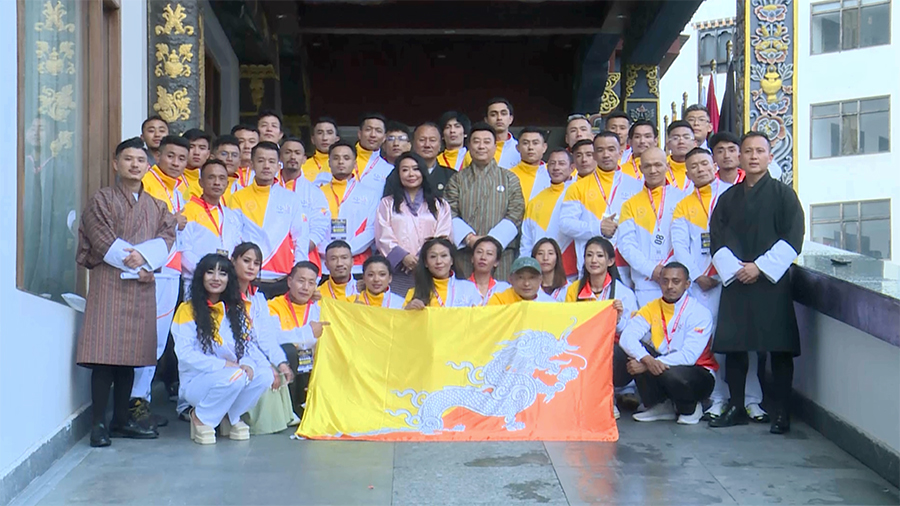
 On home ground and against the region’s strongest, Bhutan’s bodybuilders have delivered the country’s best-ever result at the South Asian Bodybuilding and Physique Sports Championships. The men’s team finished second overall at the 16th edition of the event held in Thimphu recently. Karma Wangdi reports on a result that the Bhutan Bodybuilding Association says marks a turning point for the sport in the country.
The stage was Thimphu’s own Clock Tower Square and the result, one for the record books. The Bhutanese men’s team earned 375 points, winning four gold, three silver, and four bronze medals across different categories.
Under the championship scoring system, each gold medal contributed 60 points, while silver and bronze medals carried 25 and 15 points, respectively.
For the Bhutan Bodybuilding Association, the points tell a bigger story of steady progress against some of the region’s strongest bodybuilding nations.
“It is a huge achievement because these are big names in the bodybuilding community. Countries like India, Afghanistan, Pakistan, Nepal, Maldives and Sri Lanka are much more advanced in this sport compared to us. But when we competed this time, it showed that we are improving. We are not behind these countries anymore. Our athletes are working hard, becoming more competitive, and giving their best every year,” said Sonam Tobgay, General Secretary, Bhutan Bodybuilding Association.
India topped the men’s team championship standings with 475 points after winning four gold, eight silver and three bronze medals. Afghanistan finished third with 300 points.
In the women’s team championship, India were crowned champions with 186 points, ahead of Nepal and Sri Lanka.
The 16th South Asian Bodybuilding and Physique Sports Championships brought together more than 100 athletes from seven South Asian countries. Around 85 men and more than 20 women competed in various weight and height categories during the two-day championship.
For Bhutanese athletes, second place at home is more than a medal count. It is a proof that a small federation can hold its own on a regional stage. It also sets the bar for what comes next, as they look ahead to bigger international competitions. The question this result now poses is a welcome one. It is not whether Bhutan can compete, but how far it can go.
Karma Wangdi
Edited by Sonam Wangdi