
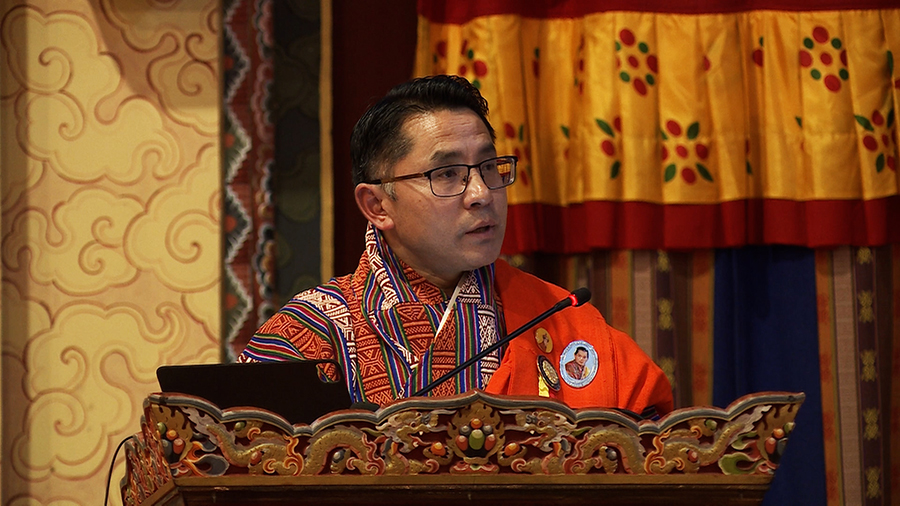
 Agriculture and Livestock Minister Younten Phuntsho introduced the Livestock Bill in the National Council today. During the introduction, the minister clarified that the proposed Bill is not intended to promote animal slaughter, while public concerns have centred on the perceived promotion of slaughter. The Bill’s key objective is to ensure animal welfare, operational standards of meat processing facilities, food security, biosecurity, and the control of zoonotic diseases.
The minister said that concerns over the Bill’s perceived promotion of slaughter reflect the religious and cultural values of the Bhutanese people and their compassion towards animals. However, he clarified that the bill does not provide a legal basis for slaughter.
“The government acknowledges these concerns among the people. They reflect our commitment to religious and cultural values and a shared sense of compassion towards animals. The government considers this a foundation of our national identity.”
He added that the Bill aims to raise the standards of existing facilities and strengthen monitoring mechanisms. According to the minister, the legislation will help ensure animal welfare, food security, public health, waste management, and accountability.
The minister said that while the government does not promote meat-processing facilities, it cannot deny an individual the right to establish such a facility if all operational requirements are met, as it is a fundamental constitutional right.
“As stated in Article 7 of the Constitution of Bhutan, a Bhutanese citizen has the right to practise any lawful trade, profession, or vocation. If the government disapproves of such a proposal without legal grounds, it would be a direct violation of the Constitution.”
He added that the country’s only meat-processing unit is currently on hold by the Bhutan Food and Drug Authority until it improves its operational standards.
Meanwhile, members of the National Council raised concerns about the need for oversight mechanisms and the government’s efforts to control the increasing number of meat shops.
“Why has an independent animal welfare oversight body not been established? Such mechanisms are widely implemented in countries like India, the United Kingdom, and New Zealand, where they help ensure proper implementation and compliance,” said Kesang Chuki Dorjee, Eminent Member, National Council.
“Meat shops are opening in almost every new building. This undermines Bhutan’s image as a deeply religious country and raises sanitation concerns. Are there any rules and regulations in place to address this issue?” questioned Leki Tshering, MP, Thimphu, National Council.
Responding to the questions, the minister said that the ministry has not received any proposals to establish an independent animal welfare oversight body. However, he added that there is an opportunity to explore such a mechanism in consultation with the Civil Society Organisations Authority.
On the increasing number of meat shops, the minister said they are private businesses, and their growth is largely driven by market demand and profit.
Bhutan spent nearly Nu 18bn importing nearly 30,000 metric tonnes of meat between 2021 and 2025. And 700 cases of illegal imports were recorded by relevant agencies between 2024 and 2025. Those involved paid a fine of Nu 21 M.
Meanwhile, according to the National Health Survey 2023, only a little over 11 per cent of Bhutanese are vegetarians.
The House will continue deliberations on the bill tomorrow.
Kelzang Chhophyel
Edited by Sonam Pem