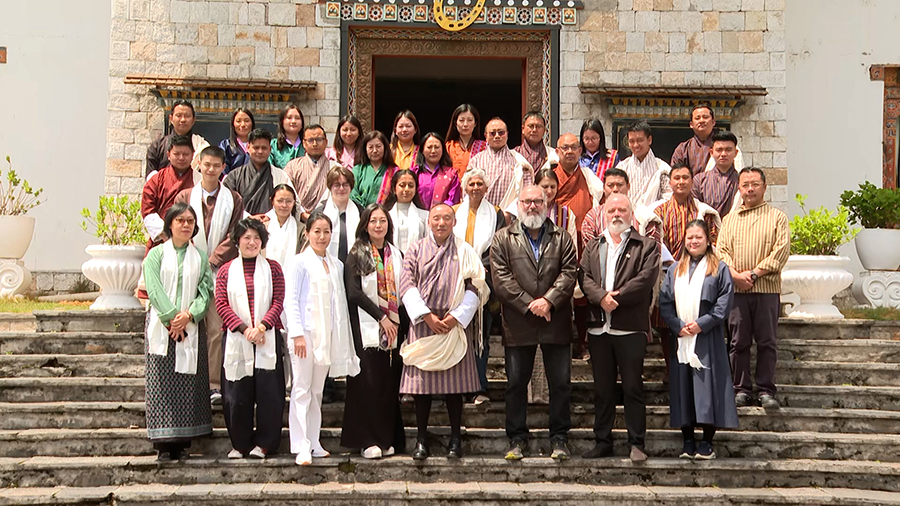
 Bhutan’s rich arts and crafts have long been showcased to the world through tourism. Today, foreigners are not just admiring these traditions, they are eager to learn the skills. Through the Bhutan Skills Programme, eleven participants from different countries are in the country to learn traditional painting, embroidery, wood carving, and Bhutanese cuisine.
The participants are from around five countries – Taiwan, Spain, Malaysia, Canada and Australia.
Their enthusiasm for learning new skills and experiencing the country’s culture has brought them here.
They are learning the skills paying 2500 US dollars for a two-week course.
Rita who came from Taiwan to learn traditional painting said, “I wanted to see how a Thangka is being painted in the traditional regional settings, in traditional Bhutanese school. I still continue to paint and I wanted to come back here with more friends, so brought more friends with me from Taiwan and they also paint thangka.”
Marina from Spain came to learn wood carving and she said “I became fascinated by all the work and intricate details that go into wood carving, which make these magnificent buildings possible. When I found out about this course, I wanted to learn more about wood carving to deepen my appreciation for this art form and architecture.”
Organised by the Department of Workforce Planning and Skills Development under the Ministry of Education and Skills Development, the programme aims to internationalise Technical and Vocational Education Training or TVET courses while promoting the country’s unique skills and cultural heritage.
Sonam Zam, an assistant programme officer of the Department of Workforce Planning and Skills Development, MoESD said, “TVET is often seen as a field that does not receive much focus in the country. Many youths choose higher or formal education after Class 10 and 12, and vocational training is often seen as a secondary choice. Through this programme, we hope to advocate for TVET and encourage more young people to consider it as a preferred choice in the future.”
For these participants, the experience goes beyond learning, it is about carrying a piece of Bhutan’s heritage into the world.
Sangay Chozom