 With the next Local Government elections less than a year away, efforts are picking up to bring more women into leadership roles. A recent training in Tsirang is giving aspiring female candidates the skills and confidence to step forward and contest.
Women’s participation in local government elections has remained low over the years. In the last elections, 491 women contested, an increase of just one candidate from the 2016 local government elections.
However, only nine were elected as gups, including two through bye-elections. Twenty-two were elected as Mangmis, and 152 as Tshogpas.
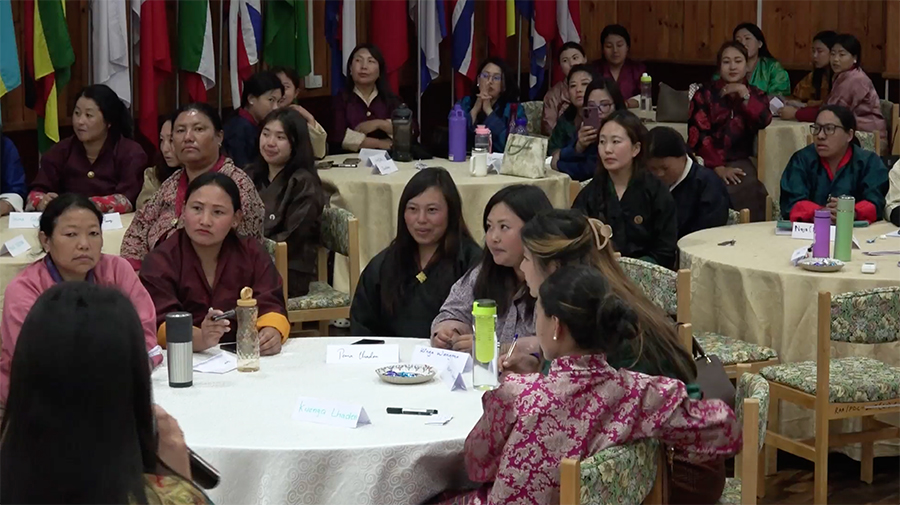
To address this gap, the Department of Local Governance and Disaster Management organised a five-day training in Tsirang.
The programme brought together 85 aspiring women leaders from 13 districts. The training focused on enhancing leadership, effective communication, public speaking, team-building, and community-engagement skills.
Participants also learned about the roles and responsibilities in local government, along with election procedures and legal processes.
“If there is equal representation of men and women in the posts of gup, mangmi, and tshogpa, the priorities of both genders can be included and addressed in the plan. This will ensure balanced service delivery,” said Chimi Dema, Participant, Paro.
“The training has encouraged me to take part in the electoral process. We have learnt that we will able to exhibit our capability and get a chance to serve our country if elected,” said Kelzang Choden, Participant, Monggar.
“In the past, there was a perception that leadership roles were only for male. But things have changed now. Women are equally capable. We only need to come forward,” said Dupchu Zangmo, Participant, Pema Gatshel.
“I decided to attend the training after discussing with my husband. Earlier, I lacked the knowledge about election and couldn’t take part in elections. After attending the training, I am confident that I will contest whether I win or lose,” said Dhan Maya Subba, Participant, Tsirang.
Experienced women leaders also joined as resource persons. They shared their journeys, experiences and achievements.
“Many participants are interested in contesting elections. However, social and cultural norms coupled by stereotypes have held them back so far. Now after three of us shared our knowledge, many have committed to take part in the fourth Local Government,” said Ugyen Yangzom, Ngatshang Gup, Monggar.
“Most of them have completed class 12, and a few of them even hold degrees. I didn’t have a formal education, but seeing my work progress and achievements, it has inspired them to contest for elections,” said Sangay Wangmo, Gozhi Mangmi, Dagana.
The Department of Local Governance and Disaster Management says increasing women’s representation will lead to more balanced decision-making at the local level. They plan to continue such training in the coming months.
“Resource allocations are all done by the Gewog Tshogde. So if we have a higher representation for the Gewog Tshogde or the Dzongkhag Tshogdu, I think it will be more advantageous for our female leaders, so they can decide what needs and requirements for women in the community,” said Sonam Tshenley, Chief Programme Officer, Department of Local Governance and Disaster Management.
For many of these aspiring leaders, the journey has just begun. Whether more women will step forward in the next elections remains to be seen.
Pema Tshewang, Tsirang
Edited by Sonam Pem