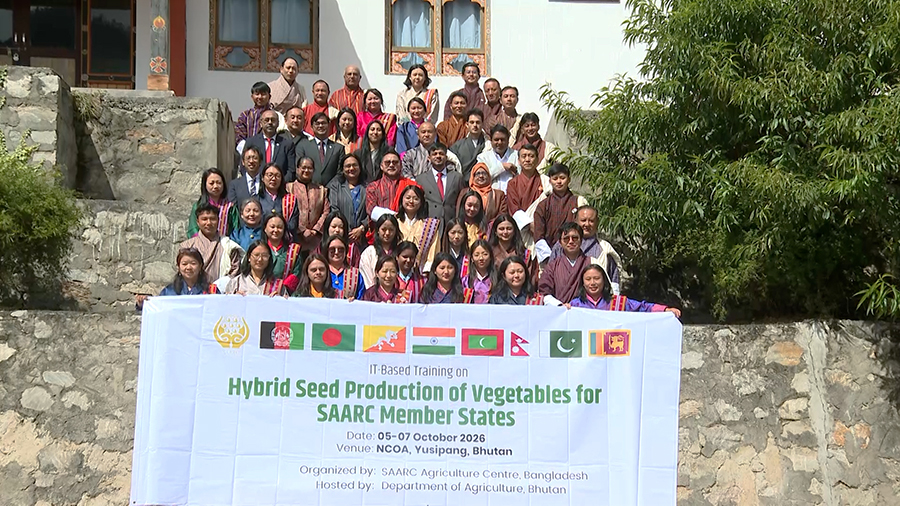
 Producing more vegetables is not just about having more farmland or better farming techniques. It starts with something much smaller: the seed. Bhutan is now looking to strengthen its capacity to produce hybrid vegetable seeds locally, as experts from across the SAARC region gather at Yusipang in Thimphu for a three-day training.
The training focuses on improving technical knowledge and skills in producing quality hybrid seeds, particularly for tomato and chilli. The training brings together agricultural experts, scientists and extension officials from SAARC member states.
“The main objective of this training is vegetable hybrid seed production, which is included in the 13th Five-Year Plan, primarily chilli and tomato. We have the basic knowledge and experience but lack advanced expertise. It is to gain advanced knowledge and skills from this training,” said Saha Bir Rai, Chief Agriculture Officer, Department of Agriculture, MoAL.
Hybrid seed is produced by deliberately crossing two selected plants to produce a new seed with the best qualities of both parent plants.
Experts say strengthening domestic hybrid seed production could help reduce dependence on imported seeds and give farmers more reliable access to quality planting materials.
Better seed could also help farmers manage risks such as erratic weather, pests and diseases, while improving yields and the quality and uniformity of their produce.
“As a technical agency, it is our mandate and our responsibility to be ahead of our farmers. For farmers to gain benefits from this training, it’s the technical agencies that have to step up. Hopefully, technical agencies will be able to take forward this training and then bring it as a successful endeavour in the fields of the farmers, especially in the areas of pest management, disease management, germination and consumer preference,” said Ugyen Wangmo, Programme Officer, National Centre for Organic Agriculture.
“Reasons to produce hybrid seeds are due to climate change, global warming, mechanisation, and urbanisation. With such events, germ infestations are increasing day by day, and for that reason, hybrid seed will maintain quality. Whenever you have improved your variety by different crossing beyond the original purity, then it is more prone to infection by any disease bacteria, virus or fungi. That’s why we need to be really careful in consideration, preparation and safety measures to maintain the quality and control,” said Taslima (PhD), Senior Technical Officer, SAARC Agriculture Centre.
Researchers are being trained in techniques from parent plant maintenance and seed handling to storage and quality control through expert-led lectures, laboratory sessions, field demonstrations and group discussions.
For now, the work is happening in training rooms, laboratories and demonstration fields.
But the real test will come when these techniques move beyond the training and into farmers’ fields.
Pelden Wangchuk
Edited by Sonam Pem