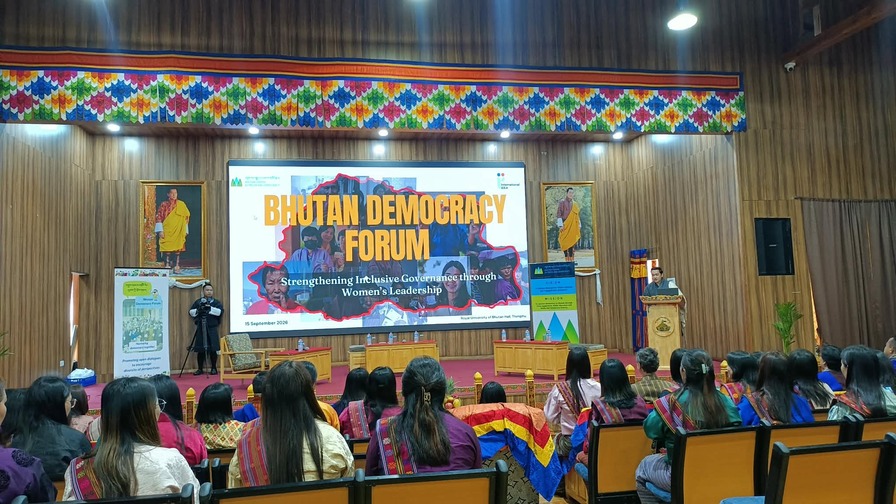
 For women seeking elected office, the challenge begins long before polling day. A needs assessment done by Bhutan Centre for Media and Democracy (BCMD) has found that the barriers are not limited to social attitudes. Campaign costs, mobility, childcare and the demands of political campaigning can make it difficult for women to enter and sustain a political career. The findings were presented at the Bhutan Democracy Forum 2026 in Thimphu today, as stakeholders discussed what needs to change ahead of the upcoming LG elections.
The 2026 needs assessment by the Bhutan Centre for Media and Democracy (BCMD), conducted across Samtse, Chhukha and Trongsa, examined the experiences, challenges and needs of 113 women, including current Local Government leaders and aspiring candidates.
The assessment was conducted between January and March this year.
Rather than focusing only on whether women are willing to contest, the assessment examined what makes it difficult for them to actually participate in elections.
One of the key concerns is the financial burden of campaigning. Participants identified campaign financing and financial dependence as challenges that can affect a woman’s ability to enter the electoral race on an equal footing.
For LG elections, aspiring candidates have to create a new bank account and deposit up to 70 thousand ngultrum as campaign fund before the campaign begins.
For some, the challenge extends beyond campaign expenses.
Safe mobility, travelling for campaigns and attending activities late into the night can create additional difficulties, particularly for women who continue to carry responsibilities at home.
Childcare was also identified as a practical barrier.
“As the local government election is approaching, BCMD carried out multiple activities. At the beginning of this year, we did a needs assessment in three districts to understand what some of the barriers were that limit women from taking up leadership roles. Based on the needs assessment that we did, our findings mainly revolved around three broad themes. The first one is on the legal and policy framework. The second one on the structural and system barriers. The third one is on the social-cultural norms,” said Kencho Tshering, BCMD.
The assessment also found that political participation is influenced by factors outside the formal electoral system.
Support from family and spouses, endorsement from respected community figures, and public perception can influence whether women decide to contest and how they are received once they do.
Rumours and public scrutiny were also identified as concerns, highlighting how the political environment can affect women differently even when the law provides equal opportunity to contest.
While proposals such as temporary special measures and greater representation of women within political parties could improve participation, participants said changing the rules alone may not remove the practical obstacles women face.
“When we talk about the difficulties, it is not that women face something completely different from men. It is more about how, when we serve our communities and have to prioritise plans, some chiwogs that are closer to towns get better roads and a better supply of drinking water. However, some communities do not get the same level of services. So, because women are the ones who use these services more often in the communities, these issues tend to affect women more,” said Sangay Lhamo, Shaba Gup, Gup, Paro.
“I am contesting for the next election. When I started becoming a contestant, I found that women are facing problems such as public speaking. So, if government or non-government offices can provide them with such programmes where they build their capacity, if these things are provided, I think women will also be able to perform like men in local government,” said Sherab Zangmo, an aspiring woman leader from Pema Gatshel.
“But by standing in this election, I want to prove and be an example to the youth that we can do a lot apart from our household work. And I am immensely grateful to BCMD for giving us very skilful training. By attending this training, I feel very confident, and I feel that I can serve my community confidently and I can provide full support to women in my community,” said Heera Devi Chhetri, Aspiring Woman Leader, Samtse.
For women aspiring to contest the Fourth Local Government Elections, entering politics is not simply a question of deciding to contest. It is also about whether they have the financial, family, logistical and social support needed to compete on equal terms.
Anita Chhetri
Edited by Phub Gyem