
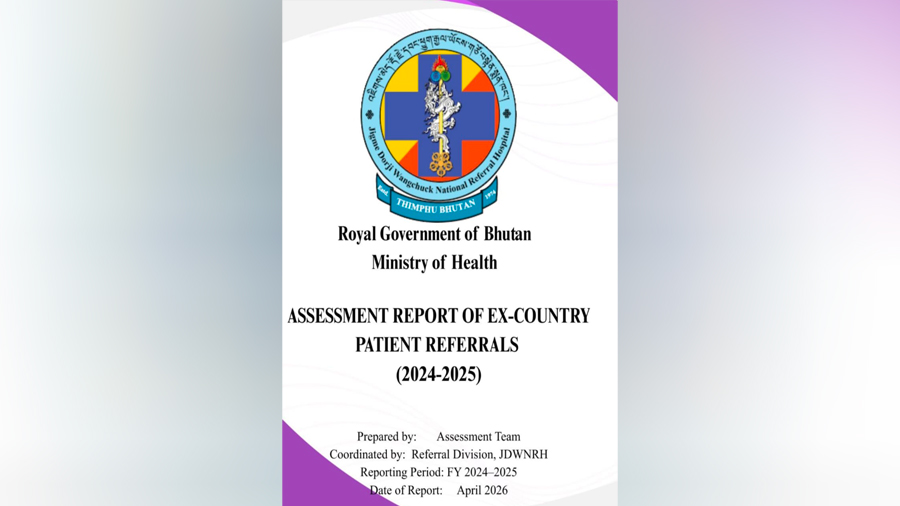
 Cancer remains the leading reason why Bhutanese patients are referred abroad for treatment, placing a growing financial burden on the country’s health system. An assessment of ex-country patient referrals found that Nu 730 M was spent on overseas medical treatment in the 2024-2025 financial year. The assessment also found gaps in documentation and patient follow-up, and calls for stronger medical services within the country.
For many Bhutanese patients, seeking specialised treatment still means travelling abroad. And cancer remains the biggest reason for these referrals. It is followed by conditions affecting the blood vessels in the brain, blood-related diseases or disorders and problems affecting the bones, muscles and joints.
According to the assessment, cancer-related costs were Nu 23.64 M between 2024 and 2025.
Among the most common cases were gynaecological cancers with 70 patients referred, followed by gastrointestinal cancers with 66 cases, and lung cancer with 56 cases.
Kolkata in India was identified as the primary destination for overseas medical travel, receiving 72.3 per cent of all referred patients. Tata Medical Centre in Kolkata alone treated 421 patients, accounting for roughly one-third of the total caseload.
However, according to the assessment, the actual cost of cancer-related cases could be much higher. This is because medical bills for many patients at Tata Medical Centre could not be fully traced during the financial audit due to incomplete documentation and the large number of cases.
The assessment also found serious gaps in monitoring patients after they were referred.
43.8 per cent of all cases, involving 548 patients, had no recorded treatment outcomes. This means there was no complete information on what happened to many patients after their treatment abroad.
To address these gaps, the report recommends introducing digital referral and tracking systems, strengthening documentation and monitoring, and conducting regular clinical audits.
Over 1,250 patients were sent for medical referrals during the assessment period. Farmers made up the largest group, followed by unemployed individuals and housewives. Farmers accounted for 284 cases, or 23 per cent. They were followed by 257 unemployed individuals and 201 housewives. Civil servants accounted for 128 cases.
Despite the challenges, the report found the referral system has helped many patients access life-saving specialised treatment. About 87 per cent of patients returned after completing treatment.
With the number of patients requiring overseas treatment and the cost of overseas treatment continuing to rise, the assessment stresses the need to strengthen specialised medical services at home.
Singye Dema
Edited by Sonam Pem