 The country’s urban planning and developmental activities are likely to become more efficient. As part of a project focused on enhancing the climate resilience of the urban landscape, a new framework was launched today. It will bring together relevant stakeholders for better coordination right from the planning and design phase through to execution. This will ensure public infrastructure is built to withstand the impacts of the changing climate and minimise waste of public resources.
Quite often, newly built public infrastructure such as roads and footpaths have to be excavated even before use for reconstruction, resulting in extra work and waste of public resources.
The reason? Poor planning resulting from a lack of coordination among implementing agencies.
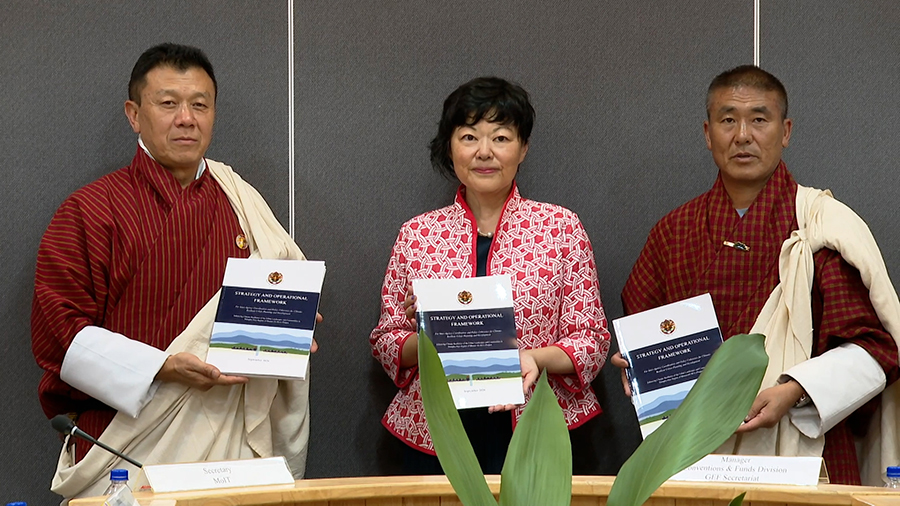
To address these challenges, the Ministry launched the Strategy and Operational Framework for Inter-Agency Coordination and Policy Coherence for Climate-Resilient Urban Planning and Development in Thimphu.
The Ministry of Infrastructure and Transport launched the framework in collaboration with the Global Environment Facility and the United Nations Development Programme.
The framework will ensure better inter-agency coordination, policy coherence and more integrated and climate-responsive approaches to urban planning and development.
The framework was developed as part of the Enhancing Climate Resilience of the Urban Landscapes and Communities in Thimphu-Paro region, ECRUL project. It is funded by the Global Environment Facility.
“Quite often we find that these various aspects are guided by their own set of policies, own set of mandates that the parent agencies are subject to achieve. So quite often we find that these agencies end up working in silos, no matter the effort that is being put into coordination. And that, in the end, leads to wastage or inefficient use of resources, whether it’s in terms of technical resources or in terms of financial resources,” said Tshering Penjor, the Project Manager for the ECRUL Project under the Department of Human Settlement.
Enhancing Climate Resilience of the Urban Landscapes and Communities in Thimphu-Paro region was launched last year as a six-year project. Worth over USD 82 million, with GEF funding USD 20 M and the Royal Government co-financing over USD 62 M, the project focuses on reducing climate risks through nature-based solutions, improved water and watershed management, climate-resilient infrastructure, and inclusive urban planning.
The framework will focus on improving inter-agency coordination to enhance urban planning and development activities in Thimphu and Paro region.
“And these two regions are also among the highly urbanised centres in all of the nation. And whether the infrastructure or the developments in these centres are able to cater to any climate-induced risks, that is also a concern that is being raised since a majority of the communities or population are residing in these two areas. The hope and the expectation through this framework or this strategy is if we could revisit or relook at some of the mandates, some of the roles and responsibilities of those various agencies involved and see how they can be more streamlined,” added the Project Manager.
As urban areas continue to grow, the framework aims to ensure that climate resilience and coordination are considered from the outset, helping make future development more efficient and better prepared for climate-related risks.
Sonam Yuden
Edited by Phub Gyem