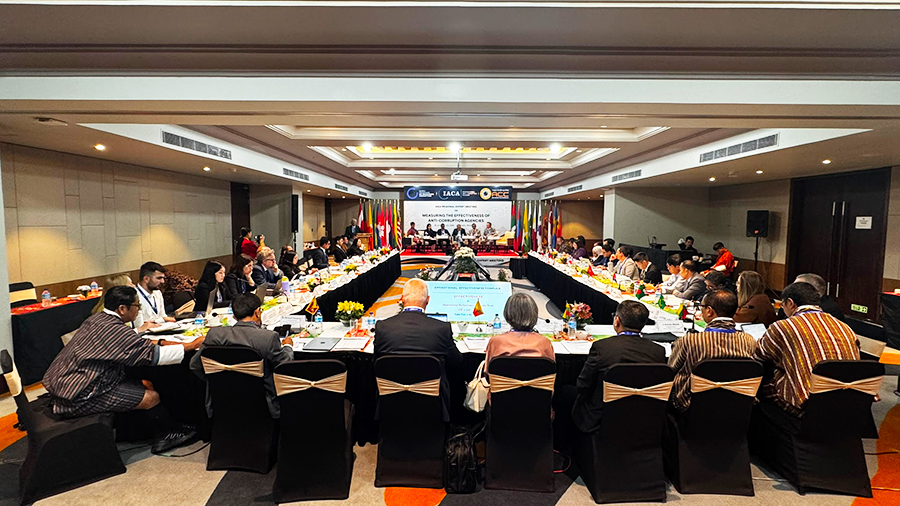
 People are more likely to report corruption when they trust the institutions meant to fight it. Experts say that public confidence is just as important as the number of corruption cases investigated or solved. This was one of the key messages at the Asian Regional Expert Meeting on Measuring Anti-Corruption Effectiveness, which began in Thimphu today. The Anti-Corruption Commission, in partnership with the International Anti-Corruption Academy, is organising the three-day event.
At a time when countries are rethinking how to measure success in the fight against corruption, one message stood out at the meeting: effectiveness is not only about how many cases are detected or resolved, but also about the level of public trust in the system and anti-corruption efforts.
Experts say that public trust is central to the effectiveness of anti-corruption agencies.
“I think that public trust is very important to every anti-corruption agency, because public trust is a determinant matter for members of the public to decide whether they will come forward to an anti-corruption agency when they encounter corruption issues in their daily lives. So, in turn, public trust will affect the effectiveness of the anti-corruption agency’s work,” said Angel Kwok, Chief Academy Officer, Independent Commission against Corruption, Hong Kong SAR, China.
“If anti-corruption agencies are focused only on performance, without taking into consideration public trust and public confidence, the organisation may be perceived as not effective. In many cases, I have found, and even in my study, law enforcement and anti-corruption agencies that enjoy a very high level of public trust can get cooperation from the public. People come forward and give a lot of good-quality information or allegations against corruption offences,” said Tan Sri Abu Kassim Bin Mohamed, Chairman, Perdana International Anti-Corruption Champion Foundation, Malaysia.
In Bhutan, public confidence in the Anti-Corruption Commission has gradually declined over the years.
According to the National Integrity Assessment 2025, 85 per cent of respondents still consider anti-corruption efforts to be generally effective. However, the proportion of people rating the Commission as “doing very well” has steadily decreased between 2012 and 2025.
The Commission attributes this trend to awareness about the Commission varying significantly among the general public.
“In terms of public trust, if you really look at the complaint trends that the ACC has been receiving over the years, you can see an increasing trend of complainants coming forward with their identity. That shows confidence and trust in the way the ACC handles complaints and ensures confidentiality. In that way, we can say that while the ACC may not be meeting the fullest expectations of the people, it is gradually progressing towards meeting those expectations,” said Rinchen Namgay, Senior Planning Officer, Policy & Planning Division, Anti-Corruption Commission of Bhutan.
Over the next two days, the meeting will focus on enhancing political finance transparency and exploring the use of artificial intelligence in corruption detection and prevention.
The three-day meeting brings together 34 international delegates representing 15 anti-corruption agencies across Asia, along with representatives from regional organisations, academia, and Bhutan’s national institutions.
The meeting is part of the International Anti-Corruption Academy’s Global Programme on Measuring Corruption, which has since 2022 worked with anti-corruption practitioners worldwide to develop a more robust, country-tailored methodology for assessing progress against corruption.
Tashi Dekar
Edited by Sonam Pem