Despite widespread access to electricity, many households, particularly in rural areas, still rely on firewood and liquefied petroleum gas (LPG) for cooking. Against this backdrop, the government has also been driving a national transition to cleaner cooking fuels. Now, a new private initiative, backed by carbon finance and using the country’s hydropower-generated electricity, is set to bolster that effort.
Smoke continues to rise from traditional kitchens across Bhutan every day. According to the National Statistics Bureau’s Annual Environmental Accounts 2025, Bhutanese households consumed more than 71 thousand cubic metres of fuel wood in 2024, equivalent to roughly seven thousand truckloads of firewood. During the same period, households also used more than 8,300 metric tonnes of LPG and more than 250 kilolitres of kerosene.
Continued reliance on traditional fuels carries significant economic, environmental, and health costs. It places pressure on forest cover and exposes families to indoor air pollution. The World Health Organisation links household air pollution from solid fuels to respiratory illness and other health complications, with women and children at particular risk, given their greater time near cooking areas.
“LPG imports have grown by about 3 per cent annually over the past decade, averaging to almost 8,700 metric tons per year, and that is costing us in the range of 188 to 540 million annually. This growing dependence exposes the country to foreign exchange pressure, supply chain disruptions, and global fuel price volatility,” said Karma Tenzin, Director, Department of Forest and Park Services, MoENR.
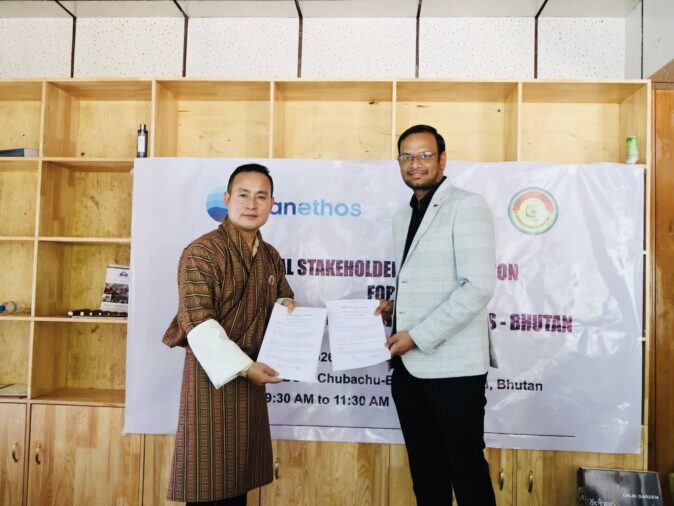
It is in this context that the Horticulture Association of Bhutan, in partnership with Planethos Private Limited in India, launched the Planethos Clean Cooking Project. It aims to promote energy-efficient electric cook stoves. The project will be piloted between June and July, involving around 200 households, before a wider rollout.
“The project can help reduce tree-felling and protect our forests. The electric cook stoves will be helpful for rural people because they will not produce indoor pollution,” said Tshering Wangchuk, President, Horticulture Association of Bhutan.
He added that the project will enable farmers to participate in carbon credit opportunities. Besides, carbon finance mechanisms will be explored to help subsidise stove distribution and maintenance. While the subsidy structure has not yet been finalised, discussions are underway on how to make the technology affordable for households across the country.
“On the subsidy, we are planning to set it at par with the national wage rate for two to three days. We are still discussing the exact figure, and it is yet to be finalised,” said Tshering Wangchuk, President, Horticulture Association of Bhutan.
A comprehensive validation report will be compiled following the pilot project. It will be submitted to a joint committee representing the governments of Bhutan and Singapore. If approved, the nationwide distribution is expected to start from August. Project officials said that the initiative could reduce around 1.2 tonnes of carbon emissions per household annually.
The Planethos Clean Cooking Project complements broader government efforts to expand clean cooking technologies nationwide and maintain Bhutan’s carbon-negative status.
According to the Ministry of Energy and Natural Resources (MoENR), the government has installed more than 8,700 household biogas plants nationwide. More than 650 energy-efficient induction cook stoves have also been distributed across the country, with additional units reaching highland communities, including Merak and Sakteng in Trashigang. Besides, under the National Clean Cooking Policy 2025, the government is exploring a phased rollout targeting around 30 thousand households, with priority given to rural, remote, and vulnerable communities.
Bhutan has invested heavily in hydropower for decades. As the country seeks to expand the use of electricity beyond export and into household energy consumption, initiatives such as this will test whether clean electricity can play a larger role in everyday cooking practices. The long-term impact will depend not only on the number of stoves distributed, but also on whether households choose to adopt and continue using them.
Achal Darjee and Tenzin Lhadon (Interns)
Edited by Sonam Wangd