
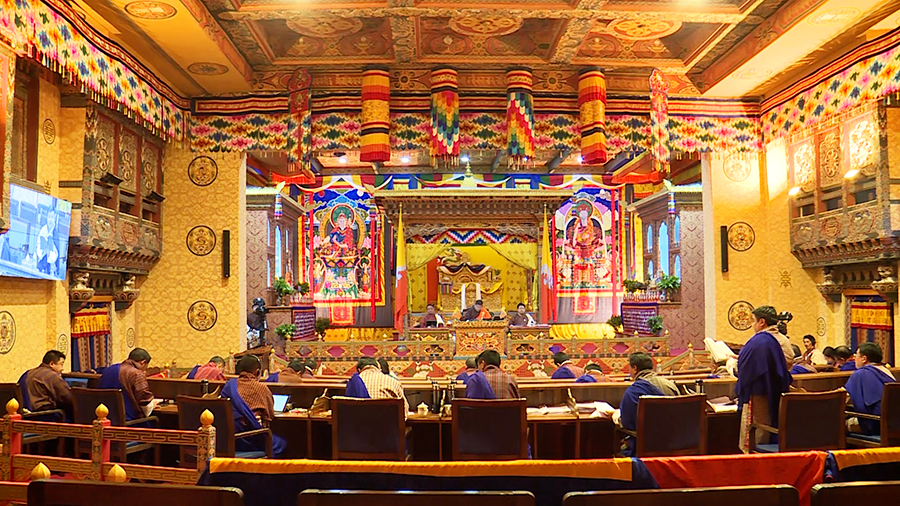
 Once again, the Members of Parliament raised concerns about the underutilisation of the capital budget. During deliberations on the Budget Appropriation Bill for Financial Year 2026-27, a National Council member suggested reducing the capital budget to reduce the fiscal deficit. Another member expressed concern about the limited funding for religious and cultural services.
The budget bill proposes a total expenditure of Nu 153.3bn for the fiscal year, with Nu 72.5bn for capital expenditure, which accounts for 47.3 per cent of the total allocation.
So, Eminent Member Phuntsho Rapten questioned the continued increase in capital allocations when significant portions of the budget remain unspent each year.
“We know that the capital budget remains underutilised every year. If we reduce proposed capital allocation of Nu 72.5bn by 10 per cent, it would come down to about Nu 65.3bn. Such a reduction would lower the fiscal deficit from Nu 25.2bn to 18.1bn.”
Meanwhile, Gasa MP Tshering expressed concern over the inadequate budgetary allocation for the religion and cultural service sector.
“Our peace, harmony, and unity are deeply rooted in our religion and culture. Many people are concerned about the relatively low budget allocated to this sector. We are already witnessing the gradual loss of some traditions, and increased funding would help preserve it.”
Responding to the concerns, the Economic Affairs Committee of the House acknowledged that underutilisation of the capital budget has been a recurring issue. However, the committee said the increased capital budget in the Financial year 2026-2027 is due to implementation of most of the activities under the 13th Five-Year-Plan.
Jamyang Namgyal (PhD), Deputy Chairperson of Economic Affairs Committee said,“We are now at the midpoint of the 13th FYP, which is also a peak implementation period. Ministries and agencies are expected to undertake more activities during this phase, and the increased budget allocation may be attributed to these implementation requirements.”
According to the budget report, the estimated capital expenditure is 72.5 billion ngultrum, accounting for 29.6 per cent of the total capital outlay under the 13th Five Year Plan.
This represents a significant increase from 16 per cent in Financial Year 2024-25 and 25 per cent in Financial Year 2025-26. The report stated that higher capital allocation reflects a transition from groundwork and preparatory activities to full-scale implementation.
The government meets the capital budget mostly from grants and loans and allocates the budget on the development of infrastructure including roads and buildings among others.
The Economic Affairs Committee added that the religion and cultural service sector has not been neglected, noting that it has been allocated Nu 2.8bn.
Of this, Nu 792 M has been allocated to the Department of Culture and Dzongkha Development for restoration, conservation, redevelopment, and construction works at key religious and cultural sites, including Talo, Tango, Sangchoekhor, Rigsum Goenpa, Dechenphodrang, Trashi Yangtse Dzong, Tsirang Dzong, Zhemgang Dzong, Barshong, Sarpang Dzong, the Bhutan Monastery at Lumbini, Bhutanese temple at Sarnath, Varanasi, and Gyalsung Lhakhangs. In addition, Dratshang Lhentshog has been allocated Nu 455.5 M to support infrastructure improvements, new construction works, and the preservation of monastic and heritage sites.
The Bill is scheduled for adoption tomorrow.
Deki Lhazom/Kinley Bidha