
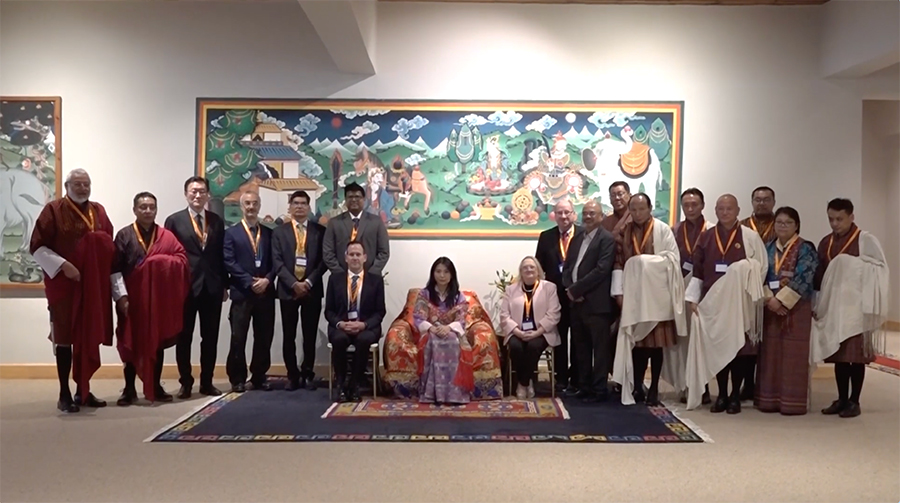
 The Institute of Electrical and Electronics Engineers (IEEE), one of the world’s largest professional technology organisations based in the United States, has partnered with Bhutan to host the Engineering Education, Research and Innovation Summit. Graced by Her Royal Highness Princess Chimi Yangzom Wangchuck, the two-day summit began today in Paro. The summit focuses on how engineering education can support Bhutan’s digital transformation and sustainable development goals.
The summit brings together international experts, academics and policymakers to discuss the future of engineering education, research and digital transformation.
During her address, Her Royal Highness Princess Chimi Yangzom Wangchuck spoke about how technological development should be grounded in and aligned with Gross National Happiness philosophy, keeping innovation focused on well-being, sustainability and ethics.
“The question before us is not whether technology will shape the future, it certainly will. The more pressing question is whether we can shape technology according to our values. Can innovation advance human well-being? Can artificial intelligence support inclusion and opportunity? Can progress remain sustainable and compassionate? These are questions that deeply align with Bhutan’s philosophy of gross national happiness.”
The event is exploring ways to modernise engineering curricula, strengthen research capacity, and better prepare students for emerging technologies, including artificial intelligence.
Organisers say discussions focus on shifting engineering education from theory-based learning to more application- and skills-oriented approaches aligned with the needs of a rapidly evolving digital economy.
The summit is also looking at strengthening university research ecosystems, expanding global collaboration, and addressing infrastructure gaps to improve equitable digital access across the country.
President and CEO of IEEE, Mary Ellen Randall said, “A lot of the educational programmes that you are promoting have practical applications. They are very environmentally friendly. You have experiential education built into the system already. People are looking at real-world problems. All those things are going to make engineers for the future, and it is happening today.”
IEEE is giving a six-month complimentary access to key digital resources to support technology advancement and research.
The support includes access to the IEEE Xplore Digital Library, which provides over seven million documents including journals, conference papers, standards and technical literature, as well as the IEEE eLearning Library with expert-led online courses in engineering, computing and emerging technologies.
Mary Ellen Randall said, “We bring people together to collaborate both in a written word but also in convening experts together to talk about things, to challenge each other’s thinking, to enlarge where we are going, to dream, all those things. I think it will be helpful to both of us to share these experiences.”
The two-day summit continues tomorrow with further discussions on engineering education, innovation, research collaboration and Bhutan’s digital transformation journey.
Karma Samten Wangda, Paro