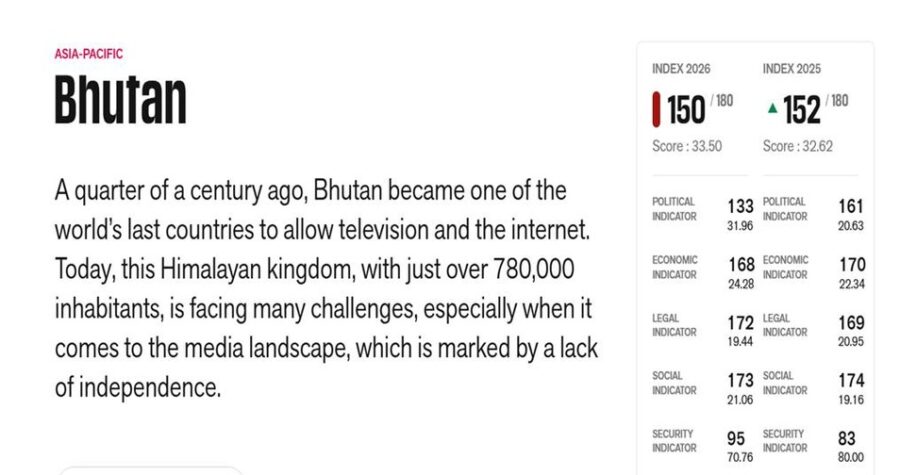
 After four years of steep decline, Bhutan’s Press Freedom Ranking has shown a slight improvement. According to the latest World Press Freedom Index by Reporters Without Borders, the ranking moved to 150th place from 152nd last year. The RSF Index was released yesterday. Despite the improvement, Bhutan still falls under the “very serious” category, indicating a significant challenge to media freedom.
The RSF Index evaluates press freedom in 180 countries based on five indicators: political, economic, legislative, social, and security.
Bhutan’s Press Freedom Ranking improvement is driven mainly by the political indicator, where it rose to 133 from 161 last year.
Bhutan’s social indicator ranking also improved slightly from 174 last year to 173 this time. But it still is a concern. According to the assessment, this highlights self-censorship as a major concern, where journalists avoid covering sensitive issues due to social and cultural pressures.
Similarly, challenges still persist in the legal framework. Bhutan’s legal indicator dropped three places to 172 from 169 last year, reflecting continued constraints on press freedom. The report states that the government-appointed media regulator (BICMA) maintains strong control, while journalists face difficulty accessing official information. Defamation and national security laws also make critical reporting risky, limiting press freedom and reducing public access to important information.
The security indicator also declined, with Bhutan slipping to 95 this year from 83 last year, indicating growing concerns about the safety of journalists.
Over the last four years, Bhutan’s Press Freedom Ranking has seen a sharp overall decline. From 30th position in 2022, the ranking dropped to 90th in 2023, then moved further to 147th in 2024 and 152nd in 2025, before showing a slight improvement this year.
Despite the slight improvement, journalists on the ground describe a more complex reality shaped by social pressure, and legal constraints.
Sangay Rabten, who has been working as a journalist for the last eight years, says access to information remains one of the biggest challenges on the ground. “When it comes to official information, whether from government officials or other agencies, there are strict protocols and timeframes. By the time we get a response, we often lose valuable time, our stories become stale, and in some cases, the information is not provided at all.”
Kinzang Lhadon, another journalist, adds that most media houses are staffed by young reporters, making it challenging to cover complex or sensitive stories. “Even when they do obtain it, there is always the fear of legal consequences, such as defamation or being sued for factual errors. This happens even when journalists believe they have reported accurately, as facts can sometimes be challenged or manipulated by other parties.”
“Bhutan has made notable progress in the World Press Freedom Ranking. However, the ground reality is more complex than it appears. Many journalists continue to face challenges, particularly in accessing information due to bureaucratic hurdles. Additionally, the rapid spread of information on social media often undermines the credibility of mainstream media,” says Dorji Choden, another journalist.
According to the 2026 RSF World Press Freedom Index, the global press freedom situation remains under pressure, with many countries continuing to fall under the ‘difficult’ category.
The report also highlights that media organisations worldwide are increasingly struggling to balance editorial independence with financial sustainability, a challenge that continues to affect smaller media markets like Bhutan.
Meanwhile, Norway continues to hold the top position in the index, maintaining strong performance across all five indicators. At the lower end of the ranking, countries such as China, North Korea, and Eritrea remain among the most challenging environments for press freedom.
Tashi Dekar
Edited by Phub Gyem