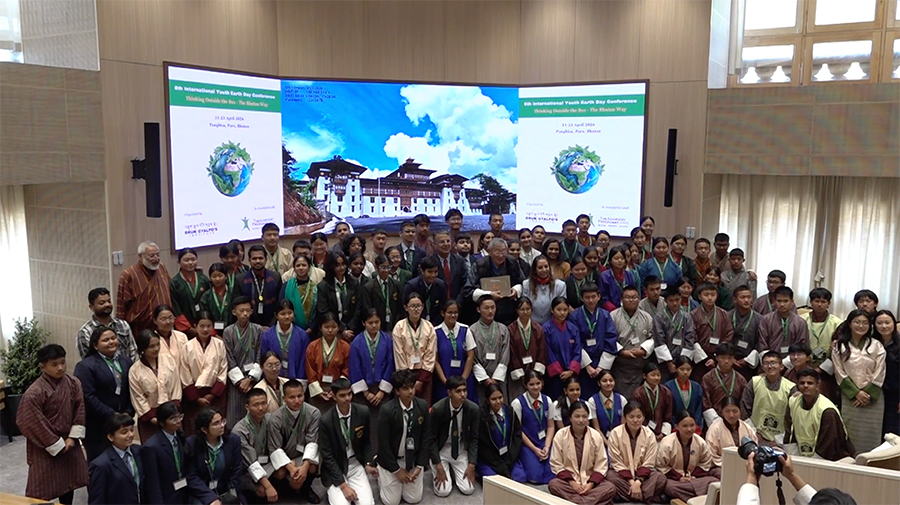
 Earth Day, celebrated annually on April 22nd, is often marked with messages and pledges. But for a group of students in Paro, it became a space to test real ideas that could shape how people live, travel and build in the future. At the Druk Gyalpo’s Institute, around 80 students from Bhutan and India came together, not just to talk about climate change but to work through solutions.
Bhutan is already experiencing the effects of climate change. Changing weather patterns and growing urban pollution are becoming part of daily life. Against this backdrop, the gathering focused on how simple, everyday decisions can help build a more sustainable future.
Organised in collaboration with The Achievers Programme, a learning, teaching and research organisation in India, the event encouraged students to look at real-world challenges. Discussions centred on how buildings, transport systems and communities can reduce environmental impact in practical ways.
Some ideas explored the use of cleaner technology. One group proposed panels fitted onto buildings using microalgae and moss to absorb carbon dioxide and filter harmful air pollutants.
“So, our idea consists of a panel that can be installed on the exterior of buildings. So, it consists of microalgae and moss that absorb carbon dioxide from the air. And it has activated carbon, which purifies particles like PM2.5 and nitrogen oxides to make the air that the citizens breathe cleaner,” said Varada Pujari, a participant from India.
Others focused on daily habits. A student-led carpooling initiative aimed to reduce the number of vehicles on the road, cut emissions, and improve transport efficiency.
“Our main idea that we had is of carpooling, revolutionising carpooling into something known as the LAMZANG project, which we are following, GNH policy, sustainable growth, in order to mix it together with a carpooling system to revolutionize travel, transport, so that we are able to bring greater advantage to the earth and reduce the CO2 production,” said Ugyen Rigsel, participant.
Participants said the experience helped them see sustainability as part of everyday life, not a distant goal. They pointed to issues such as increasing traffic, urban growth and changing lifestyles as areas where change can begin.
At the same time, students said young people still need more space to be heard on climate issues. They added that platforms like this help them share ideas, challenge each other and turn concepts into workable solutions.
“Honestly, I think young people are not being heard enough on climate issues and sustainability. And I think this conference itself is a powerful movement to help youth be heard enough on raising global issues like climate change and sustainability issues,” said Tshultrim Dolkar, a participant
“Attending such conferences, I do feel that voices are heard, but there can be more platforms for such voices to be voiced better,” said Garab Chogyal Tobgay, another participant
Organisers said the true impact of the initiative will be seen after the event, as students take these ideas back to their schools and communities. Even small changes, they said, can make a meaningful difference when applied consistently.
“Everybody at the schools, especially the school children, that’s where our forte is. They’re doing their bit, no doubt. In fact, sometimes I think they are the ones actually doing it on the ground, whereas these big environmental and climate change conferences are doing it in conference halls. But on the ground, it is the students and the volunteers who are doing the real work,” said Taranvir Guron, Founder, The Achievers Programme.
“What we are trying to do is to create a platform where students can come together from all over the world and collaborate, engage in dialogue and problem-solving concerning some of the most pressing problems globally,” said Yangchen Dolkar, a researcher at the Druk Gyalpo’s Institute
There are plans to make the gathering a regular platform in Bhutan, bringing together young people to collaborate and develop solutions to pressing global challenges.
In a country that measures progress through Gross National Happiness, such efforts show how small, practical actions can help protect both the environment and the well-being of future generations.
Karma Samten Wangda, Paro
Edited by Sonam Pem