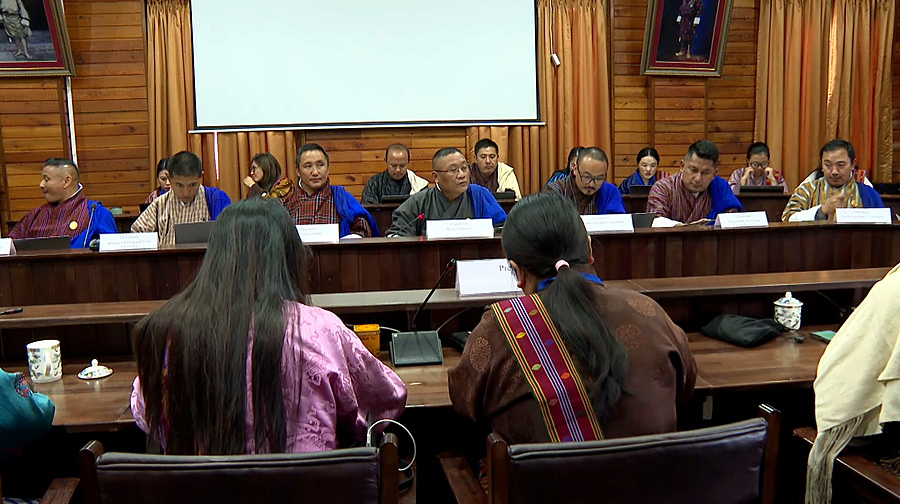
 The Pay Revision Bill will be deliberated during the upcoming Sixth Session of the National Assembly, with the proposed salary increase and its percentage to be announced when the Finance Minister tables it in Parliament on 3rd December. This was confirmed during a press conference by the National Assembly today.
According to the session schedule, the pay revision is expected to be adopted next month following deliberations in Parliament.
While government employees await the revision, concerns remain over rising prices and the impact of inflation on the wider population.
Deputy Speaker Sangay Khandu said farmers, who do not directly benefit from government salary increases, remain particularly vulnerable to inflation, which affects everyone regardless of their employment status.
He said Parliament has been discussing ways to control rising prices and called on consumers to report cases of goods being sold at excessively high prices.
“There are organisations responsible for monitoring such practices, and consumers should also come forward and report cases where goods are being sold at excessively high prices. We have strict rules and policies in place to address such issues,” he said.
On the private sector, the Deputy Speaker said businesses operate independently, with limited government authority over their salary decisions. However, he said employers could consider revising salaries following a government pay revision, depending on their financial capacity.
He said some private sector employers had followed the government’s lead during previous salary revisions.
Meanwhile, Economic and Finance Committee Chairperson Kuenzang Thinley said the proposed increase would depend on the country’s financial capacity. Parliament will also consult relevant agencies, stakeholders and the Pay Commission before making decisions on the revision.
He said the consultations would also consider how the proposed revision could benefit both government employees and those working in the private sector.
The press conference also discussed calls for tougher penalties for violence against children, following the recent incident involving a 12-year-old child.
Chairperson of the Women, Children and Youth Committee, Lhaba Lhaba, said the Office of the Attorney General (OAG) would lead the process of introducing the proposed changes as a government bill through the Cabinet.
She said the Penal Code of Bhutan would need to be reviewed in connection with the matter.
The Sixth Session of the Fourth Parliament will also see the introduction of the Mines and Minerals Bill 2026, five years after an earlier version was shelved following a disagreement between the two Houses of Parliament.
Parliament will review several action-taken reports and committee findings during the session. These include reports on the Zero-Tolerance Policy on Pornographic and Violent Online Content, irrigation and drinking water, and strengthening Early Childhood Care and Development facilities.
Other reports will cover the MaX Performance Evaluation System for civil servants, the Budget Report for the 2026–2027 financial year, and performance audit reports on CARLEP and the Waste Prevention and Management System, among others.
The Sixth Session will begin on Thursday and conclude on the 28th of next month.
Sonam Yuden and Namgay Wangdi
Edited by Sonam Pem