
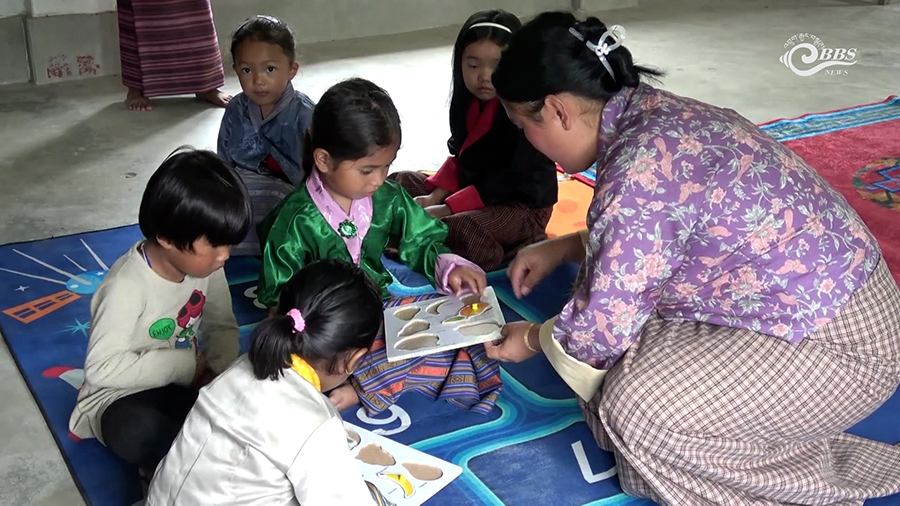
 In 2021, 75 ECCD facilitators and district education officers in Tsirang, Trashigang and Punakha were trained to help caregivers manage stress, build confidence and strengthen relationships with children. Five years on, it seems caregivers are reaping the benefits.
As they teach children, the parents also get an opportunity to develop these life skills. They also visit homes to provide counselling and support.
Karma Chimi, ECCD Facilitator in Tsirang said,“We have seen some differences. Before the programme, parents were not able to understand their emotions. Now, they understand their feelings better.”
“After we started the programme, children began interacting more with their friends and parents. They have improved significantly in communication, playing and even something as simple as eating,” said Pema Zam, ECCD Facilitator, Tsirang.
An evaluation of the pilot programme found reduced feelings of depression and anxiety, along with improved self-esteem among caregivers.
“When they ask about my troubles and listen to me, I can open up more. What they share helps me understand better, see things from a wider perspective, and feel a little better,” said Dechen Wangmo, a parent in Tsirang.
Another parent, Sarswati Chhetri said, “When the facilitator comes, we don’t just learn during her visits. We carry those lessons home. Even while cooking or doing other chores, we now know how to better care for and engage with our child.”
“I don’t have a vehicle, and taking my child to the centre takes a lot of time. I have to stay with my child there, while I also have responsibilities at home. That is why home visits make a big difference for us,” said Buddhi Man Tamang, also a parent.
According to a psychiatrist with the national referral hospital, children, especially those under two years old, develop attachments that can influence their mental health.
“If the mother, say, for example, is suffering from depression, she’s not able to take care of herself, let alone the child. And because of the behavioural or psychological issues related to her mental illness, this can actually influence the attachment between the children, where it will not be secure. It will be an insecure attachment, and this child will not be able to build that resilience mentally,” said Dr Ngawang Samten, a psychiatrist at JDWNRH.
The UNICEF and education ministry started the programme covering more than 500 children and caregivers in three districts. Caring for the Caregiver is not a mental health treatment programme. Instead, it aims to prevent and reduce psychological distress and social isolation by strengthening caregivers’ emotional wellbeing and support systems.
It complements Bhutan’s National Parenting Education Programme. While the parenting programme equips parents with knowledge and practical skills to support their children’s development, the Caring for the Caregiver focuses on the wellbeing of the caregivers.
Delivered through 432 community-based ECCD centres, the National Parenting Education Programme has reached nearly 9,000 children since it was introduced in 2019.
For caregivers, sometimes having someone to listen to can make a difference. And for children, that support can mean growing up with a caregiver who is more confident, emotionally supported and better prepared to respond to their needs. This is particularly important during a child’s early years.
Singye Dema/Pema Tshewang, Tsirang
Edited by Tandin Phuntsho