
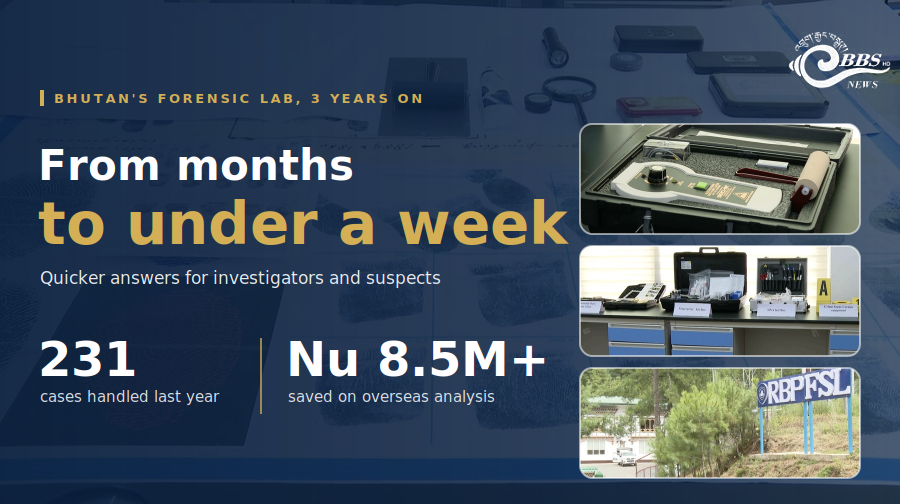
 What once took months now takes less than a week. Since Bhutan’s forensic science laboratory opened some three years ago, police say the entire process, from analysing evidence to producing a report, has accelerated. This has translated into quicker answers for investigators and suspects while saving millions for the public exchequer.
Last year, the forensic lab handled 231 cases. Of these, 102 involved DNA, 92 were digital forensics, and 29 were fingerprint cases.
From January to August this year, it handled another 90 cases, including 52 DNA cases, 25 digital forensics cases, and 13 fingerprint cases.
Not long ago, none of this could be done in Bhutan. Evidence had to be sent outside the country, and the wait for results could take around a year.
In 2021, police records reported that 137 forensic cases, involving more than a thousand samples, had been sent to India and other countries for analysis.
Bhutan’s first forensic science laboratory is established at Serbithang in Thimphu. It has been operational since November 2023, bringing DNA, fingerprint, and digital forensic services under one roof.
Having evidence examined within the country cuts two ways. For investigators, it means quicker access to evidence that can help identify a suspect. For someone under suspicion, the same evidence can help rule them out.
The development has also saved money. According to the police, in 20 months since it began operating, the laboratory has saved more than Nu 8.5 M in overseas courier and analysis costs.
Forensic science remains an integral part of investigations because a phone, a fingerprint, or even a tiny biological sample can become crucial pieces of evidence in establishing what happened at a crime scene.
DNA analysis can help identify or rule out individuals, while fingerprint examination can link people to objects or crime scenes. Digital forensics, meanwhile, helps investigators recover and analyse evidence from electronic devices.
Deki Lhazom
Edited by Sonam Wangdi