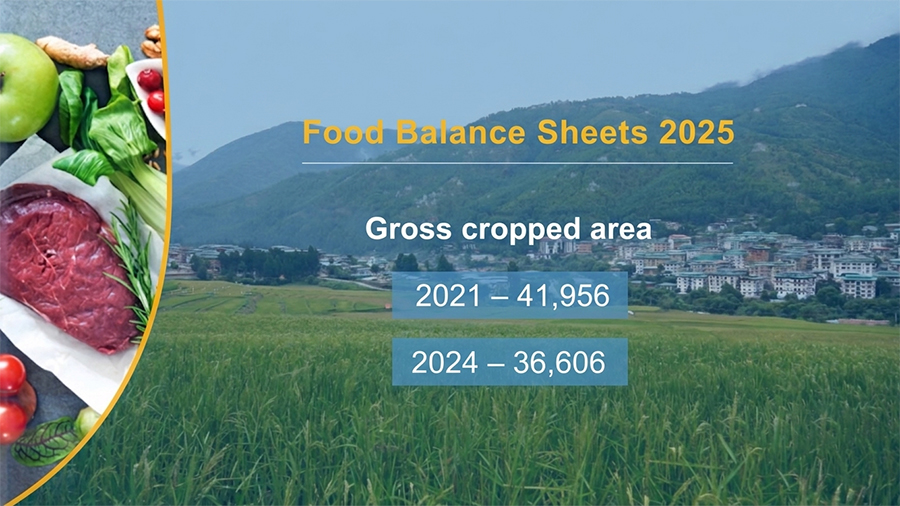
 The land Bhutan uses to grow food has been shrinking. The country’s first Food Balance Sheet Report shows the total cropped area fell by about 13 per cent in just three years. The steepest drops were in cereals and spices, the crops that fill Bhutanese plates, and, in the case of cereals, the crops the country still cannot grow enough of.
Between 2021 and 2024, the total land planted with crops fell from almost 42,000 hectares to around 37,000 hectares. That is a loss of more than 5,000 hectares in just three years.
According to the National Statistics Bureau, which compiled the report with the Food and Agriculture Organisation of the United Nations, further study is needed to establish exactly why the land is going out of use.
The fall was sharpest among spices, particularly cardamom and ginger. The area harvested for spices nearly halved, from 6,081 hectares in 2021 to 3,351 hectares in 2024.
However, Bhutan is self-sufficient when it comes to spices. The National Statistics Bureau attributes this to lower domestic consumption, with a large share of such crops being exported.
Cereals remain Bhutan’s biggest crop, taking up about 53 per cent of all cropland in 2024. But the area under cereals also shrank, from 22,007 in 2024 to 19,511.
The biggest cereal losses since 2021 were in maize, rice, millet, and buckwheat.
Even as cereals dominate the fields, Bhutan is unable to produce enough to feed itself. In 2024, about 66 per cent of the cereals the country used were imported.
According to the National Statistics Bureau, Bhutanese eat far more cereal, rice above all, than the country’s farms produce.
Meanwhile, as per the report, some foods are almost entirely brought in. Sugar and stimulants such as coffee, cocoa, and tea had a 100 per cent import-dependency rate. This was followed by vegetable oils at 83 per cent of import dependency and pulses at 77 per cent.
In contrast, the country is self-sufficient in starchy roots, tree nuts, fruits, alcoholic beverages, and eggs.
The report also tracks the national food supply in calories. The average energy available per person fell from 2,964 kcal (kilocalories) a day in 2021 to 2,768 kcal in 2024. This is a decrease of about 196 kcal, or 6.6 per cent over three years.
Going by the report, the dietary energy supply represents the food available across the country as a whole. It is not a measure of what any one person actually eats.
In Bhutan, cereals contribute nearly 58 per cent of the total dietary energy supply in 2024, with rice being the dominant staple food.
For now, amid the figures is a hard question for Bhutan. With more than half its cropland under cereals but two-thirds of them still shipped in, how can the country grow more of the food it most depends on, on less and less land?
Singye Dema
Edited by Sonam Wangdi