 As a civil servant, what do you do when an administrative decision does not quite sit right? What happens when such a decision is of the Royal Civil Service Commission, RCSC? The Constitution and the Civil Service Act 2010 provide for an Administrative Tribunal to hear appeals against such decisions. However, years since such provisions were spelled out, the tribunal has yet to be established.
A transfer, a disciplinary penalty, or a decision about performance can affect a civil servant’s career and family. While they have appeal procedures in place in the current system, the absence of an Administrative Tribunal raises questions about access to independent review.
 Section 6 of Article 26 of the Constitution states that the Commission shall ensure that all civil servants have recourse to justice through an Administrative Tribunal established to hear their appeals against administrative decisions, including those of the Commission.
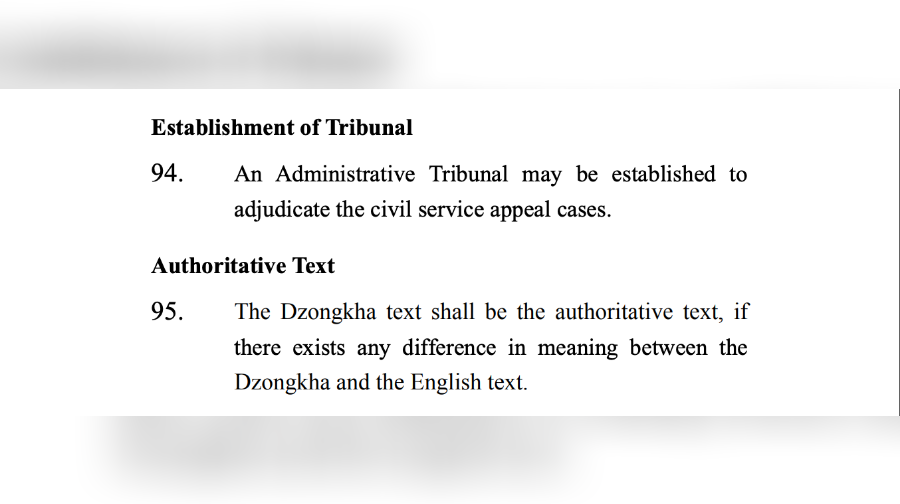
Likewise, the Civil Service Act 2010 states that an Administrative Tribunal may be established to adjudicate civil service appeal cases. It identifies the tribunal as the appellate authority for appeals from the RCSC.
However, currently, the RCSC serves as the highest appellate authority for civil-service administrative cases.
A government official, who spoke on condition of anonymity, said transfers can be particularly challenging for employees with families or those who need access to medical facilities. The official said a tribunal could provide a formal channel for employees to appeal transfer decisions and have their concerns heard.
The issue has been on the national agenda for years. In 2018, the National Law Review Taskforce recommended a new Administrative Tribunal Act. It was to help civil servants and employees of government-owned corporations redress grievances more quickly, rather than relying on lengthy and expensive court remedies.
Another civil servant who requested anonymity said, “I have never been placed in the ‘Needs Improvement’ category. But if I were somehow placed in ‘Needs Improvement’ and was dissatisfied with the decision, under the current system, I would have to take the matter to court. However, many people who receive a ‘Needs Improvement’ rating do not take it as far as the court for such a small matter. That said, it would be helpful if the RCSC could have a channel where we can raise our concerns and seek redress.”
The RCSC’s annual reports have acknowledged that the Administrative Tribunal is yet to be established. The Commission’s Annual Report 2016 had stated that establishing the Tribunal would give civil servants a full avenue of appeal against the RCSC decisions, and called for it to be established as soon as possible.
While a tribunal would not guarantee a favourable decision for civil servants, it would provide the appeal forum identified in law for decisions made by the RCSC.
“It would provide a clear and independent avenue for civil servants to seek clarification and, where necessary, appeal administrative decisions affecting them. It could also contribute to greater accountability and transparency in administrative decision-making. More importantly, it would provide an additional mechanism to review decisions and help ensure that administrative decisions are properly examined when they are challenged,” said a civil servant.
“We were not aware that the Constitution and the Civil Service Act mandate the establishment of such an administrative tribunal for civil servants. However, if such a tribunal is established, it would certainly benefit us as civil servants. And it is not just me who was unaware of this mandate. I am sure even my seniors were not aware of it,” added another civil servant.
BBS contacted the RCSC on 8th September, but is yet to receive a response. The Commission acknowledged receiving the queries and that they were under review. The outstanding questions are why the tribunal has not been established yet, how civil servants can challenge its decisions in the meantime, how many have done so, and whether there is a plan to establish the tribunal.
As per the Commission’s annual report 2024-25, the RCSC, as the highest appellate authority, took disciplinary and administrative actions on 88 civil servants. The penalties ranged from reprimand to termination.
Currently, there are more than 30,000 civil servants in the country.
Sonam Yuden
Edited by Sonam Wangdi