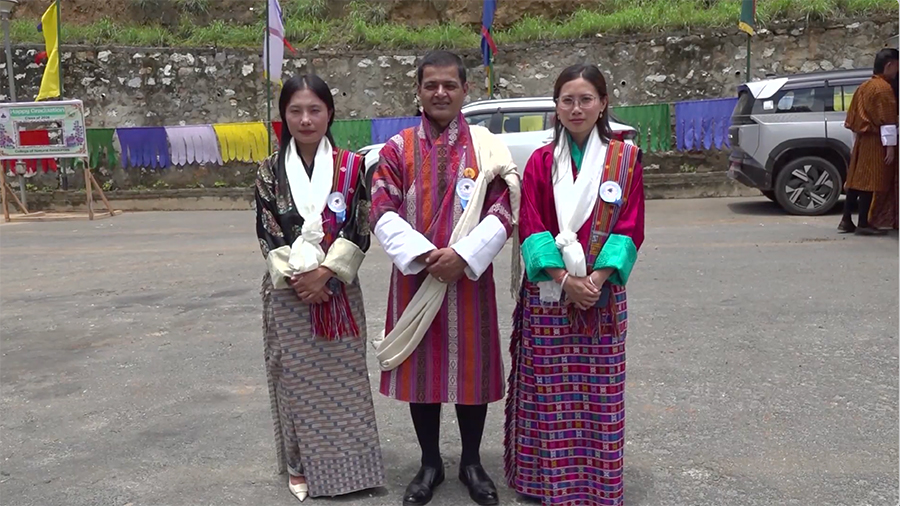
 The country now has homegrown experts trained in climate studies. The first batch of Bhutanese pursuing Doctor of Philosophy (PhD) in Climate Studies graduated from the College of Natural Resources in Lobesa, Punakha yesterday after completing their respective three-year programmes. The college introduced the PhD programme in Climate Studies in February 2022.
The three PhD graduates received their certificates during the college’s annual graduation ceremony.
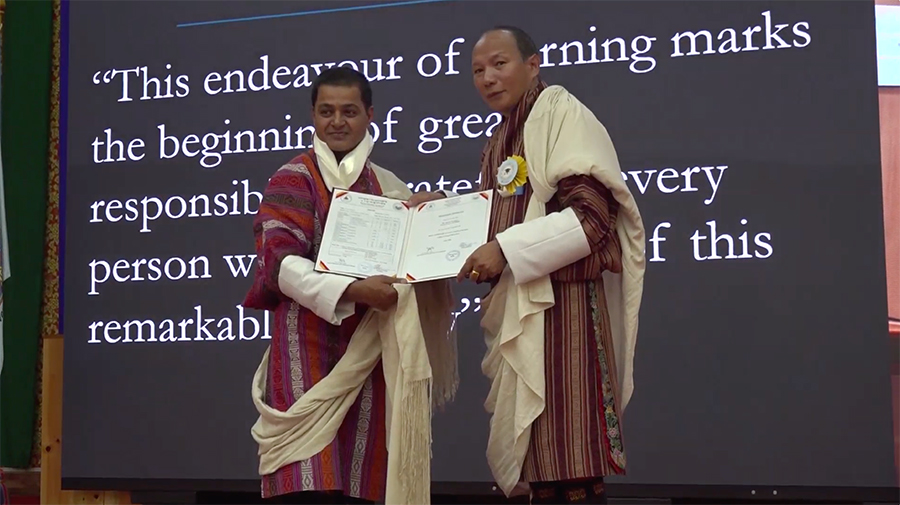
45-year-old Purna Prasad Chapagai completed his PhD with a thesis diving into how climate change is reshaping food systems in Western-Central regions. His research examines how climate change is affecting crop production, farming practices, and local dietary habits.
He is currently serving as a lecturer at the college. He holds a master’s degree in Sustainable Development from India.
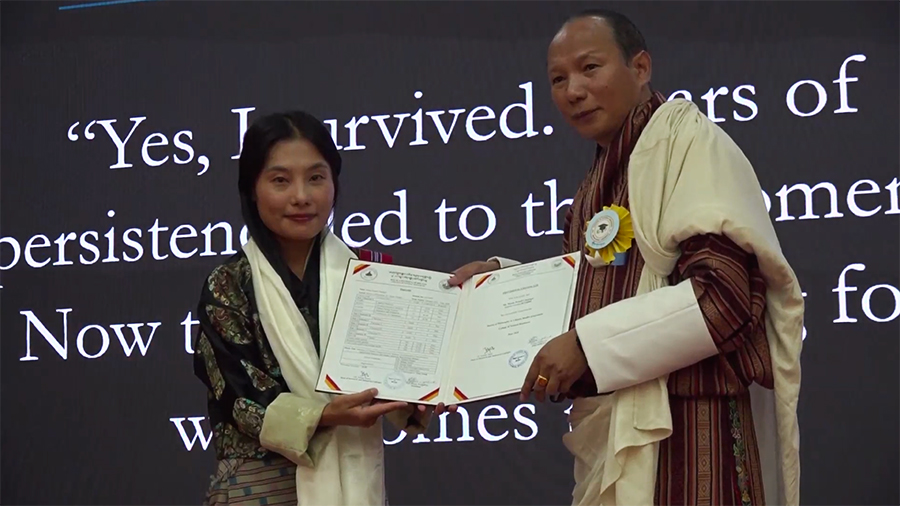
29-year-old Sonam Wangmo also completed her PhD. After completing her master’s degree in agriculture in Indonesia, she went straight into her doctoral research. Her thesis focuses on new climate-resilient farming and survival strategies for smallholder farmers in Western Bhutan.
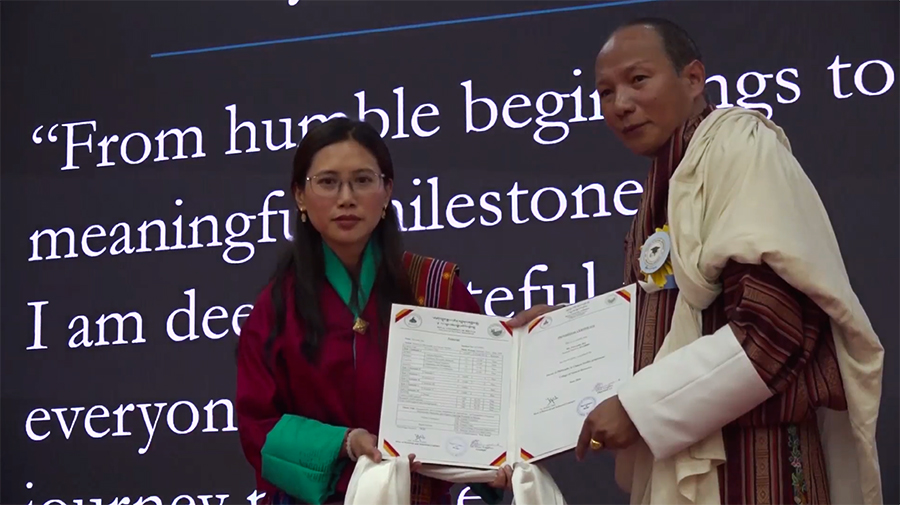
29-year-old Priyanka Rai completed her PhD with the thesis highlighting sustainable agriculture in Bhutan, evaluating how farmers view climate adaptation and the potential for organic farming.
She also pursued her PhD right after completing her master’s degree in Environmental Management.
The Tarayana Foundation provided financial support for the three-year programme.
Purna Prasad Chapagai (PhD) said, “The reason I chose PhD in Climate Studies and Food System in Bhutan is because it is relevant to us in Bhutan and I don’t need to really travel. So, there are lots of advantages. It’s bit expensive because we have to go out in the field to collect data. However, it is still comparatively lesser than going abroad.”
Sonam Wangmo (PhD) said, “When it comes to advantages in terms of pursuing a PhD in Bhutan is that we are, in a way, contributing to policy because when we go for data collection, we are doing it within the country. If I pursued a PhD in another country, this would have been a challenge.”
Priyanka Rai (PhD) said, “It was an incredible opportunity. Our college has many tutors who have completed their PhD. So, I feel that they have provided very constructive feedback on our work. I am very pleased because the course has provided me a lot of opportunities, including conferences in Sweden and also publication of our papers and posters. So, in this way, our work would be known by the research community all around the world.”
For the College of Natural Resources, launching a doctoral programme and guiding the inaugural batch to graduation elevate its institutional standing, research capability, and academic credibility.
The college has sufficient facilitators and tutors to support students pursuing PhD programmes at the college.
“Our PhD students did their research on subject matters within our country’s data. So, these research reports can be used by policymakers, which would ultimately benefit the country. Concerning their certificate, it is an internationally recognised certificate, and it will be accepted everywhere in the world,” said Tandin Gyeltshen (PhD), the Dean of Student Affairs for the College of Natural Resources.
The college currently offers the PhD programme through two pathways, a regular three-year track and a flexible six-year part-time option.
The inaugural batch consisted entirely of full-time regular students.
Another batch of four candidates is currently pursuing the programme.
Having local experts trained in climate studies ensures that the country can better develop localised, science-based solutions to pressing environmental and climate issues.
Changa Dorji, Punakha
Edited by Phub Gyem