 High in the mountains of Lunana, more than 4,000 metres above sea level, some of Bhutan’s most dangerous glacial lakes are watched around the clock, not by guards, but by technicians who live far from their families, braving extreme cold and thin mountain air. They are the early-warning eyes that keep thousands of people downstream safe. This is a look at the lives and work of the technicians behind Bhutan’s glacial lake early warning system.
Even after a night of snowfall, Jigme Lhendup begins his day early in the remote mountains of Lunana.
His destination is Luggey Tsho, one of Bhutan’s most closely monitored glacial lakes. Reaching the lake requires a trek of more than four hours across rugged terrain at an altitude of over 4,000 metres above sea level.
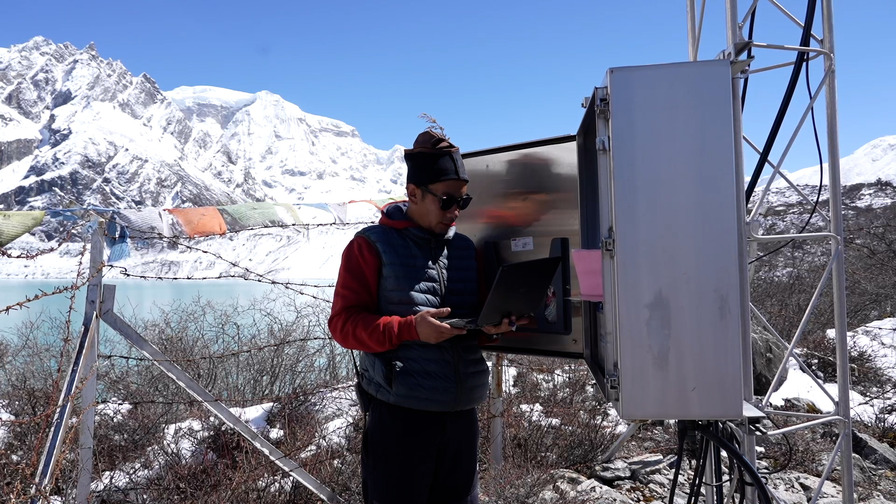
At the monitoring station, Jigme checks the early-warning equipment, assesses the condition of the lake, and reports his observations to the National Centre for Hydrology and Meteorology in Thimphu.
For the past six years, this has been part of his routine. Alongside a colleague stationed in Lunana, he makes the journey to the lake at least three times a month to help ensure the early-warning system remains operational and communities downstream stay informed of potential risks.
But there is nothing routine about the lake itself. In October 1994, Luggey Tsho broke through its moraine wall. The flood that followed surged down the Pho Chhu valley, claimed more than 20 lives and damaged the centuries-old Punakha Dzong far downstream. It remains the deadliest glacial lake outburst in Bhutan’s recorded history, and a reminder of exactly what Jigme is here to watch for.
“There is a gauge near the river, and we compare the water level readings and check whether the system is functioning properly. Monitoring is carried out from the control rooms in Thimphu and Wangdue Phodrang, where the status can be viewed in real time. If there is any malfunction, we report it to headquarters and make the necessary adjustments as directed,” said Jigme Lhendup, Technician, Lunana, NCHM.
Each station has to be checked in person, no matter the distance or the hour.
“There is also Tareyna Wachey, which is four days away from here. In Lunana alone, we are responsible for around eight early warning systems. If there is a sudden rise or unusual change in water levels, it could indicate something abnormal. So, in such cases, whether it is day or night, we have to come here and verify it and report it to the headquarters,” said Jigme Lhendup, Technician, Lunana, NCHM.
Eight systems, scattered across some of the most remote terrain in the country. And Jigme is more than a technician here. Over six years, he has become a witness to a changing climate, to glaciers that, he says, are retreating faster than ever before.
“Changes are quite drastic and visible. Glaciers are retreating faster. Thorthormi is considered one of the potentially dangerous glacial lakes, and I have personally seen significant changes there. In the past, we could see floating ice in the lake; however, it has almost become a fully formed lake now. It does not snow much during the peak winter months of January and February, but we now receive snowfall in March. Due to global warming, the risks are increasing, which is why we have these GLOF early warning systems and communication networks in place,” said Jigme Lhendup, Technician, Lunana, NCHM.
Back at the NCHM base in Lunana, Jigme and his colleague Nidup turn to another set of duties. Each day begins with numbers – water levels and weather, reported back to the flood-monitoring centres downstream.
“Here at the station, our work starts from nine in the morning: we have to report the water level and the weather update to the Wangdue and Thimphu FMRC (Flood Monitoring and Reporting Centres). We have to update that every three hours. During summer, we go to the lakes once every week, while in winter we visit them once a month,” said Nidup, Technician, Lunana, NCHM.
For Nidup, this is his first year in the highlands. He already understands the weight of the job, and its hardest parts. The thin mountain air is one. Communication is another. He worries about what would happen if an earthquake struck and the lakes shifted, and the team could not get there in time.
“During our lake visits, we have mobile connectivity in Raphstreng and Baytsho, but not Thorthormi and Luggey. So, in case of emergencies, we need to come back to connectivity to communicate with the headquarters. But our office has plans to install Starlink and cameras. In winter, when it snows heavily and the weather is bad, it also disrupts the network. We do have HF and satellite phones, but there is no network in satellite phones, and the HF also does not work at times. They use Starlink in Heldi, and they have connectivity when we don’t,” said Nidup, Technician, Lunana, NCHM.
For now, the team makes do with HF radios and satellite phones that do not always work. Nidup is hopeful a Starlink connection will reach them soon, closing a gap that, on the wrong day, could cost precious time.
Downstream, in Punakha, Wangdue Phodrang and beyond, life carries on. Children sleep. Fields are tended. Few will ever meet the two men keeping watch over the ice, thousands of metres above them. But on the coldest nights and at the oddest hours, Jigme and Nidup are still there at the water’s edge, reading the lake, so the rest of the country does not have to.
Devika Pradhan
Edited by Sonam Wangdi