
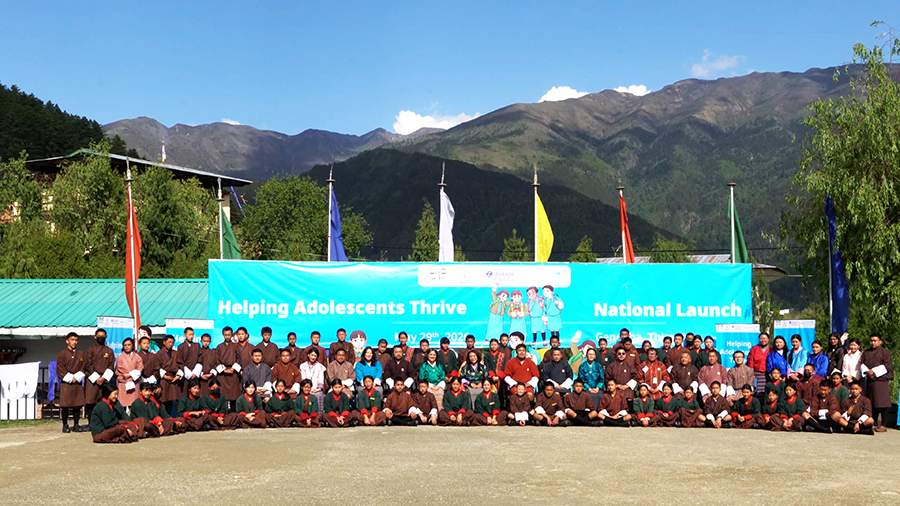
 Mental health is a growing concern in Bhutan, and schools are now at the forefront of addressing it. The Ministry of Education and Skills Development, together with the PEMA Secretariat and UNICEF, today launched the Helping Adolescents Thrive (HAT) Programme at Genekha Primary School in Thimphu. The initiative brings dedicated mental health support to students across the country.
According to the National Health Survey 2023, anxiety and depression make up more than 55 per cent of reported mental health cases in Bhutan.
The HAT programme will target adolescents between the ages of 10 and 19. The initiative will equip young people on how to understand their emotions, build resilience and reach out for support.
Under the programme, school counsellors and wellbeing focal persons will conduct sessions using locally adapted learning materials. Currently, there are over 560 wellbeing focal persons and more than 160 school counsellors across the country.
“With the change of time, there are so many new issues that are quite difficult for the leaders, parents, and caregivers to tackle. And when there are the least educated caregivers, they would definitely be experiencing difficulties handling the youth issues. So, what we do is we train the caregivers. And so we feel that our caregivers feel quite confident after getting trained in HAT,” said Nima Tshering, Dy. Chief Counsellor, Career Education and Counselling Division, MoESD.
The programme will roll out across 166 schools nationwide. By the end of this year, it is expected to benefit nearly 50,000 adolescents and around 40,000 parents and caregivers.
Prior to the nationwide rollout, the programme was piloted in 24 schools for six months last year. The results were encouraging.
“After they introduced a HAT program to us, we became friendlier with our teachers and parents. We spent more quality time with our parents, and we’re friendlier to our teachers. The teacher felt like our friend. I think the HAT program is really important because it really helps us. We should keep on having HAT programs like this more,” said Yeshey Dema, a student of Genekha Primary School.
“I think helping adolescents is very important to us, students especially, because before the ‘Helping Adolescents’ came to us, the HAT program, we didn’t know how to handle our stress. Especially like whenever we had some kind of difficult homework, or when we couldn’t handle something. Suddenly, the HAT program started last year, and then I learned about my confidence, and I knew how to communicate with others much better,” said Tenzin Yangki, another student from Genekha Primary School.
Teachers and parents also observed positive changes among adolescents.
“Last year, I was part of the caregiver programme at Changangkha Middle Secondary School. Today’s launch takes it further, and I believe it will benefit not just parents but all the children. I hope that this programme reaches private schools too so that every young person in Bhutan can benefit,” said Kinzang Tshering, a parent.
With today’s launch, the HAT programme is now officially a nationally endorsed school-based initiative, placing emotional wellbeing at the heart of education.
Namgay Wangdi
Edited by Sonam Pem