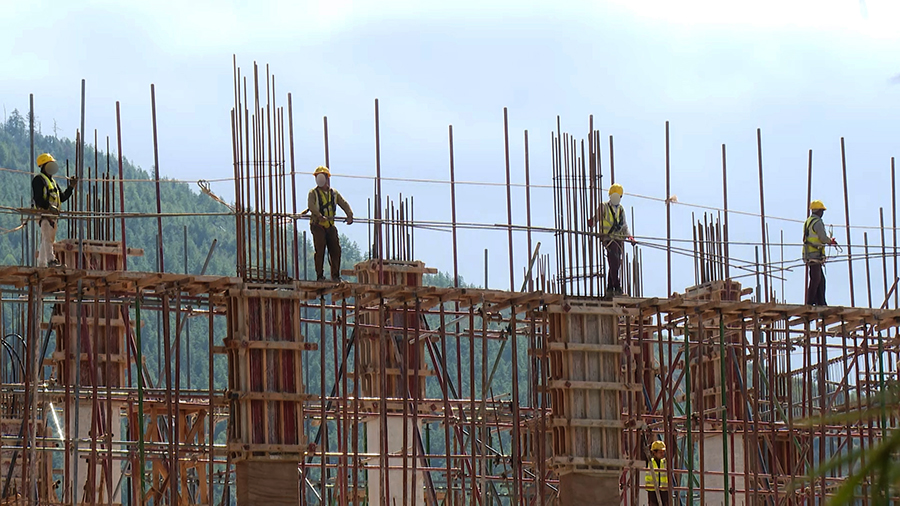
 Workplace risks remain most prevalent in sectors such as manufacturing, agriculture, construction, and mining in Bhutan. Experts say these workplaces expose workers to multiple health hazards, further worsened by systemic gaps and the growing impacts of climate change. They stress that stronger preventive measures are essential to safeguard workers’ health and safety.
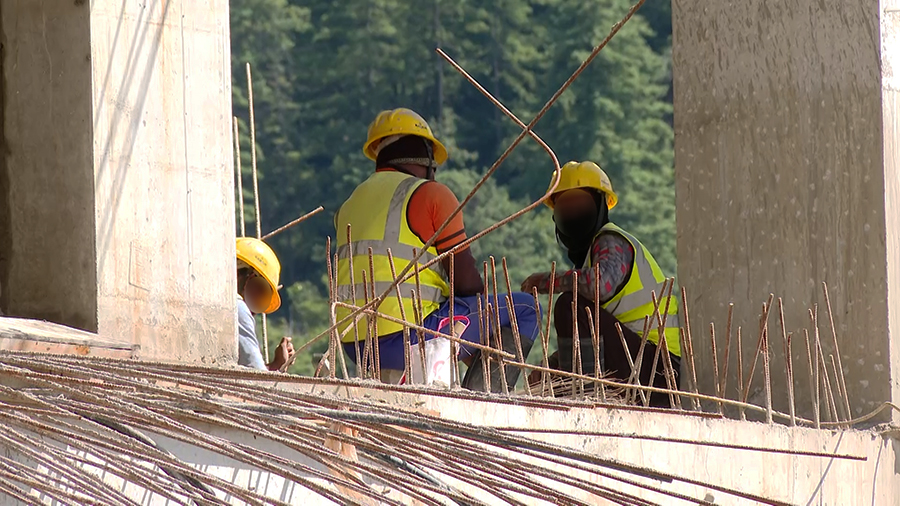 Workers are frequently exposed to hazards including heat waves, harmful chemicals, dust, excessive noise, and radiation.
Although there are no national studies on risks from heat waves, chemicals, dust or radiation, one study has examined occupational noise-induced hearing loss.
The study found that 29 per cent of workers, or 128 out of 442 people, showed signs of occupational noise-induced hearing loss.
Among those affected, more than 42 per cent experienced tinnitus, a ringing or noise in the ears without an external source.
“After a long period of exposure to sound and noise, there happens to be an erosion in the part of the ear, which cannot be restored. So that is the permanent damage because of the noise exposure. It can happen over a period of time, or from a very sudden and loud impulse noise. So we call it noise-induced hearing loss,” said Pelden Wangchuk, Chief Audiologist, JDWNRH.
Experts at the International Conference on Occupational and Environmental Health also warn that continuous exposure to workplace risks without proper protective gear can cause serious health problems.
“The common thing is the Computer Vision Syndrome, which all of us have, irrespective of whether you work in an office or you’re working in any other sector. The second thing is that those of us who are exposed to UV light are also at risk of developing what we call pterygiums and cataracts. When it comes to workplace injuries, especially in construction, agriculture, and manufacturing, eye injuries are related to flying metal pieces, dust or debris,” said Dr Dechen Wangmo, HoD, Ophthalmology Department, JDWNRH.
“Manmade climate change is the biggest crises of our human history as far as we can tell. And the impact on the workforce is great because with a world of 8 billion people, four billion people are workers. And the most important impact of climate is exposure to extreme heat, heat waves and changes in precipitation, either heavy water in terms of flood or sea rise and also droughts or the dryness resulting in wildfires,” said Thomas H. Gassert, MD, Harvard T.H Chan School of Public Health, USA.
Experts say that beyond identifying these risks, companies and industries must also put practical measures in place to prevent them.
“We can correct that by having a work rest cycle, typically 15 minutes, 10 minutes per hour or 15 minutes for every two hours in the shade away from direct sunlight. If we cycle people like this, we can maintain core body temperature, and then they go back to work for another 45 minutes to an hour and rest again,” said Thomas H. Gassert, MD, Harvard T.H Chan School of Public Health, USA.
“It starts, first of all, with the policy. It also starts with the role of the employers and the companies protecting their workers. And from the healthcare point of view, providing personal protective equipment. The second thing is, in case you get an injury, despite all the protection, seek medical attention at the earliest,” said Dr Dechen Wangmo, HoD, Ophthalmology Department, JDWNRH.
“If there are engineering controls, then we can protect the noise from the source. If the noise is protected from the source, then of course our ears are being protected. But if that is not possible, then the easiest part is to use the protective devices,” said Pelden Wangchuk, Chief Audiologist, JDWNRH.
A public health specialist from South Africa also emphasised the growing role of artificial intelligence, automation, and other emerging technologies in improving workplace safety and protecting workers’ health.
“After an accident or an injury, we usually go and inspect. But if we harness AI-enabled tools in terms of sensors and maintenance units, they can actually prevent an accident by telling us in advance,” said Barry Kistnasamy, Public Health Specialist, Department of Health, South Africa.
The 5th International Conference on Occupational and Environmental Health concluded yesterday, bringing together participants from various sectors to adopt a declaration outlining key commitments and action plans.
These include strengthening policies, improving health surveillance, building capacity, and addressing emerging risks.
The declaration also calls for protecting vulnerable workers, ensuring access to treatment and compensation for occupational diseases, and enhancing collaboration with international partners.
As economic sectors continue to grow, the way forward now lies in turning these commitments into action, ensuring that safer workplaces are not just discussed, but delivered.
Kelzang Chhophyel & Namgay Wangdi
Edited by Tshering Zam