
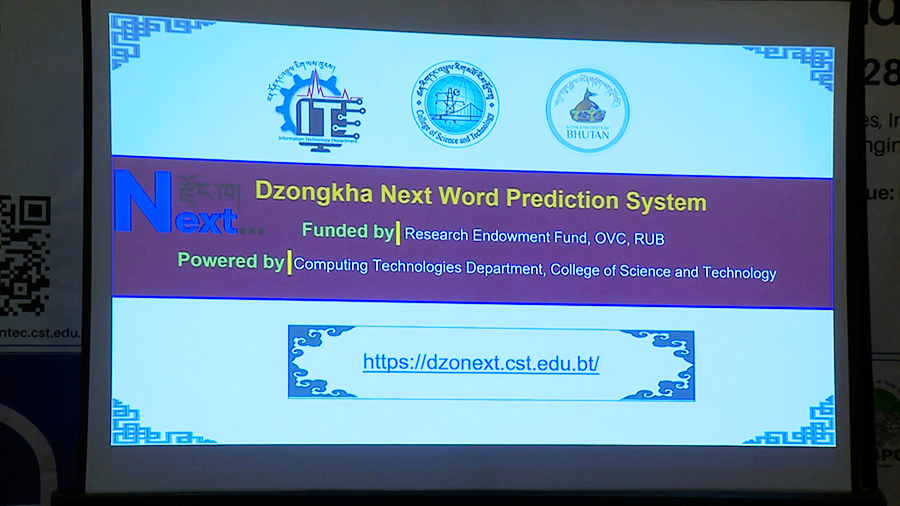
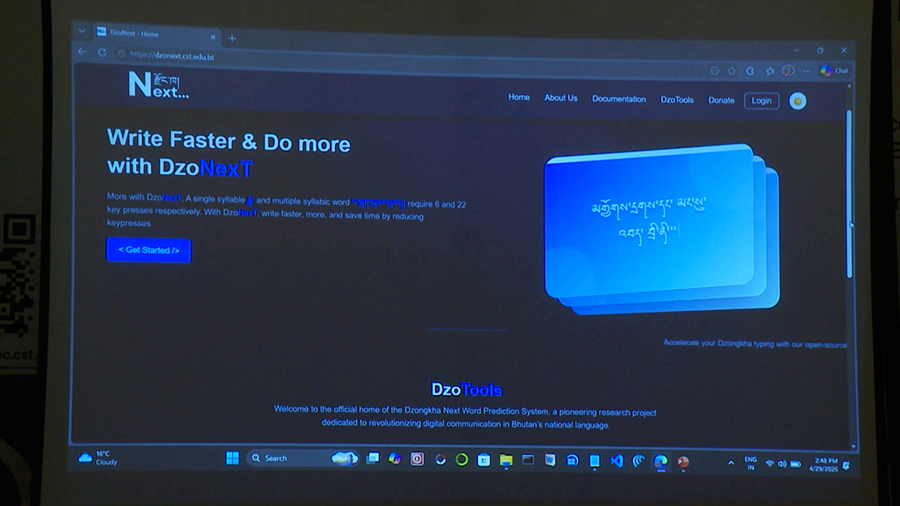
 A website called Dzongkha Next is set to make writing in Dzongkha easier and more engaging. Similar to an auto-correction feature, it predicts Dzongkha words and syllables as users type. The College of Science and Technology launched the website today during the 4th International Conference on Science, Engineering and Technology 2026 in Thimphu.
 The model contains more than 900,000 Dzongkha texts.
The texts were reviewed in consultation with the Department of Culture and Dzongkha Development to ensure accurate predictions.
“When you type in Dzongkha, it requires many key presses. So, we wanted to make writing faster. The system allows users to type the first syllable, and it then shows several word predictions. For example, if you type ‘lop’, it may suggest ‘pen’, ‘dra’, or ‘khang’. You simply select the option and continue, and the text is generated,” said Karma Wangchuk, a lecturer with the Computing Technology Department, CST.
The college began work on the website in 2020 after extensive research and groundwork. The project costs about Nu 12.3 M.
President of College of Science and Technology, Cheki Dorji said, “In the past, our students and staff could not carry out this kind of work because we lacked the necessary computing capacity. We have now acquired a high-end computing system. With this, our research team and the developers of the prediction system have moved the project to a more advanced stage.”
The project shows how investment in research can lead to practical innovation.
Conferences such as the International Conference on Science, Engineering and Technology bring together academics, students and international researchers to share ideas and strengthen collaboration.
“It’s very inspiring to see such excellent work being done by the students here. I think it would be beneficial if I could even bring my own students here in the future and have the chance for them to see the work that’s being done in Bhutan as well as to share our own work,” said Mike Henry from Shibaura Institute of Technology in Japan.
“CDCL work relates to construction, and for that, we require cooperation. Therefore, we support such a venture of a student so that their academic theory can turn into real-life practice,” said Lok Bahadur Ghalley, a general manager with CDCL.
As more Bhutanese use digital platforms to communicate, tools like Dzongkha Next could make it easier to write and use the national language online.
Developers say they will continue improving the system and servers to make Dzongkha typing faster and more accessible to users.
SIngye Dema
Edited by Sangay Chezom