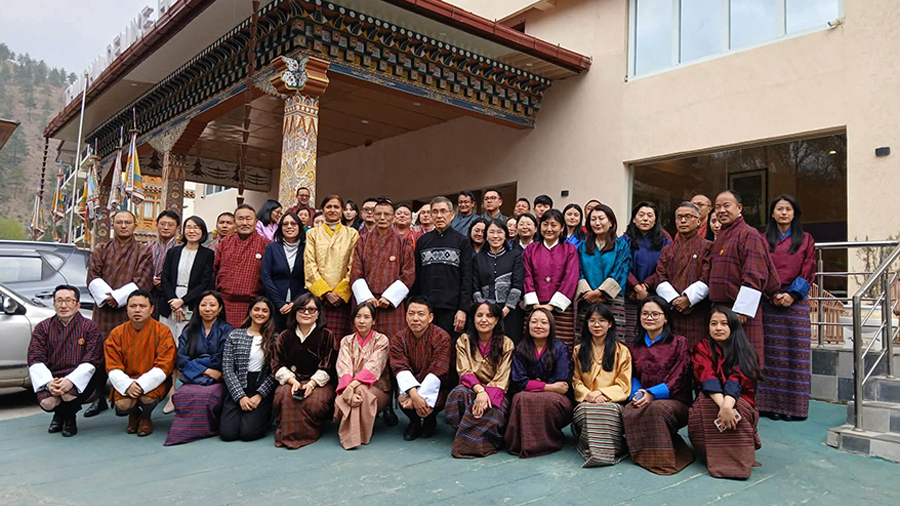
 Bhutan is set to chair the World Health Organisation (WHO) Executive Board, starting this May. To prepare for this role, the health ministry and the WHO country office are holding a four-day workshop on Global Health Diplomacy in the capital. This workshop will strengthen the capacity of health officials to have a greater understanding and skills in global health diplomacy. This will allow Bhutan to have a stronger voice in shaping global health agendas while also promoting national health priorities on a global stage.
Around 60 officials from agencies, including the Ministry of Health, National Medical Services, Ministry of Finance, and the Ministry of Foreign Affairs and External Trade, are participating in the workshop.
The sessions focus on WHO governance, negotiation skills, strategic communication, and forming national and regional positions. Health officials said this will be an important tool for Bhutan’s growing role on the global stage.
“Because of the attrition, we did lose some of our young officers, so there is now declining institutional memory in terms of such diplomacy in global health. So we now invited some experts from Thailand, Dr Suwit, who is well known in the international arena, so we have invited him and his team to build us up on this,” said Pemba Wangchuk, Health Secretary, Health Ministry.
“You (Bhutan) have a very strong primary health care base, health system. And that is the basis of the strength of Bhutan to be able to contribute to the region, to the world. So the top priority of Bhutan is to show its leadership,” said Dr Suwit Wibulpolprasert, Advisor to International Health Policy Program Foundation, Thailand.
Bhutan will hold the position of Chair for the WHO Executive Board for one year and serve as a board member for three years.
The Executive Board plays a key role in setting the agenda for the World Health Assembly and reviewing resolutions before they are adopted by member countries.
This means Bhutan will help guide important global health discussions, including priorities such as universal health coverage, disease response, and health system strengthening.
“As the chair of the EB (Executive Board), you will chair the so-called Bureau of the Executive Board. Six members from six member states, with the DG (Director General), sit together to decide which agenda will be discussed. I am sure if the chair requests that, I have only one agenda, which is wellness. I don’t think anyone will reject, because he’s the chair. Agenda setting is the first important job of the chair,” said Dr Suwit Wibulpolprasert, Advisor to the International Health Policy Program Foundation, Thailand.
“It is also the time for the WHO Director General’s election now. Therefore, the executive board has a lot of a role in this. We need to prepare ourselves so that things go well and Bhutan leads the world in terms of global health,” said Pemba Wangchuk, Health Secretary, Health Ministry.
Bhutan last assumed this role between 1996 and 1997 when health minister Sangay Ngedup served as Chairman of the World Health Organisation Executive Board.
Despite being a small country, this new endeavour will allow Bhutan to contribute more actively to decisions that affect health systems worldwide and benefit the country as well.
Singye Dema
Edited by Yeshi Gyaltshen