
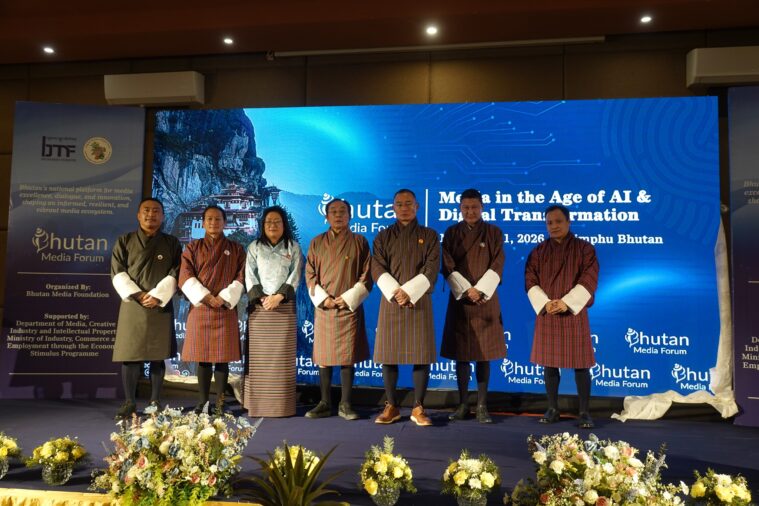
As artificial intelligence continues to reshape daily lives, the media remains no exception. But are the country’s existing laws governing media prepared for the emerging threats posed by the ever-evolving AI technology? During a panel at the Bhutan Media Forum, the country’s legislators and policymakers cautioned that the country needs to update its current legislation to keep pace with the changing digital landscape.
A recent case involving three minors has highlighted the growing risks. The girls were targeted in a case of AI-generated sexual exploitation, where their images were manipulated into explicit content and used for coercion.
Panellists at the Bhutan Media Forum said such cases expose serious gaps in the country’s legal framework. A 2024 parliamentary review, the first of its kind, found that the Information, Communication and Media Act is outdated and unable to address emerging digital threats.
“So, what it showed us is the limitations of our law. We are not equipped to handle this. We only have the ICM Act and the Penal Code, which talk about cyberbullying, identity theft and defamation. So, we know we’re very much behind,” said Kesang Chuki Dorjee, Eminent Member, NC.
GovTech officials said efforts are underway to address these gaps.
“GovTech is internally reviewing the ICM Act 2018 because there are no clauses pertaining to AI misinformation or disinformation. So, this is something which is included in our AI strategy, National AI Strategy 2025, AI for GNH. One of the key enablers there is the regulatory framework, governance and regulation. So, reviewing the existing legal framework, such as the ICM Act, is important,” said Tenzin Namgyel, Deputy Chief ICT Officer, GovTech Agency.
Bhutan Media Foundation and the Department of Media, Creative Industry and Intellectual Property organised the forum under the Economic Stimulus Programme to create a platform for dialogue among media professionals, policymakers, and young people on the future of journalism in a rapidly evolving digital landscape.
The Prime Minister, who attended the forum as the chief guest, emphasised the importance of such platforms to encourage discussions on the opportunities and risks brought by technological change.
“I am very excited about the Bhutan Media Forum. It brings together media professionals, experts, and young people to reflect on the state of our media, what we are doing well and how we can do even better. As we navigate digital and AI transformation, it is also an opportunity to discuss how we can responsibly use these tools while being mindful of the risks associated with them.”
The two-day event will see discussions on detecting deepfakes, collaboration between social media and mainstream media, and innovation in news media, among others.
Samten Dolkar
Edited by Phub Gyem