
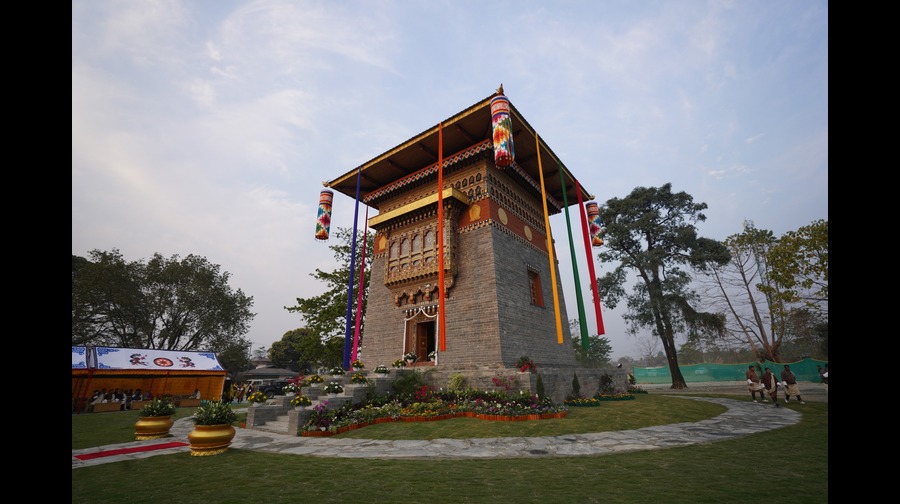
With the construction of the Ugyen Norlha Chorten near the main entry gate to Gelephu from India, visitors entering Gelephu Mindfulness City are greeted by a new aura of transformation and prosperity. The Ugyen Norlha Chorten, an elegant structure in Buddhist architecture, houses a sacred interior shrine for Ugyen Norlha, the manifestation of prosperity of Padmasambhava (Guru Rinpoche). It conveys the nation’s aspiration for spiritual wellbeing, cultural continuity, and mindful prosperity.
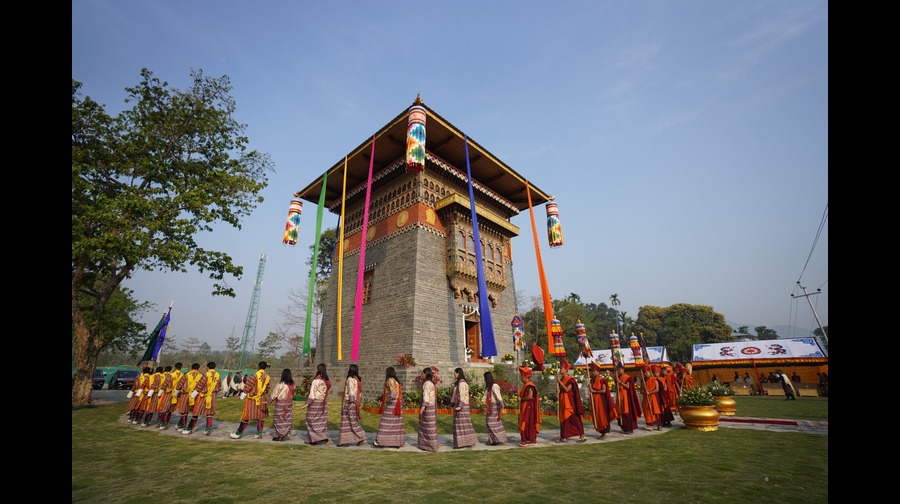
On February 21, 2026, His Holiness the Je Khenpo and the dratshang (central monk body) performed the Rabney (consecration) ceremony for the chorten which stands near the Bhutan-India border as a symbol of greeting visitors the Bhutanese way. Already an iconic landmark, constructed by the dratshang, it was inaugurated by His Majesty The King, His Majesty the Fourth Druk Gyalpo, Her Majesty The Gyaltsuen, and Members of the Royal Family as a space for reverence, blessings, and reflection, and as a celebration of Bhutan’s enduring Buddhist traditions.
The Chorten also commemorates the birth of Her Royal Highness the Gyalsem. The dratshang offered the mendrel ku-sung-thuk (prayers for wellbeing and long life) to Her Royal Highness, a profoundly meaningful ritual in the perspective of Vajrayana spirituality and Bhutanese system. It is an expression of the monk body’s commitment to the Royal family and His Majesty The King’s vision.
The Ugyen Norlha Chorten is the first spiritual feature completed in GMC and the only sacred site existing today which is dedicated to all the deities of prosperity. The central figure adorning the shrine room is Ugyen Norlha, embodying the aspiration of GMC to grow into a spiritually vibrant and economically robust city.
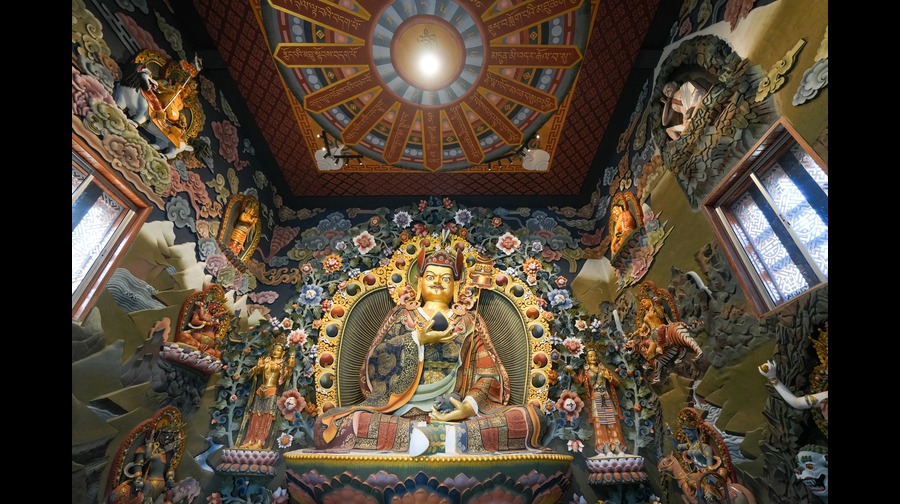
As a manifestation of Guru Rinpoche, Ugyen Norlha transcends worldly material wealth and represents the enlightened prosperity of a mindfulness city. His presence invokes both material well-being as well as the abundance of enlightened qualities – the wisdom, compassion, and realisation that true prosperity arises from removing inner and outer obstacles and pacifying negative forces.
The sacred forms in the shrine symbolise the concept of Gelephu Mindfulness City. Prosperity and spiritual values are not in conflict. A society need not choose between economic well-being and spiritual integrity. When development is grounded in compassion, wisdom, and cultural depth, it can nurture prosperity that is both meaningful and lasting. Mindfulness and material life are mutually supportive forces.
Lopon Pema Gyeltshen of Zhung Dratshang, explains that the path is not to renounce the world, but to transform one’s relationship with it, engaging with clarity, generosity, and kindness. Wealth, when generated and used with awareness, becomes a genuine force for good. The Ugyen Norlha Chorten is itself an expression of that aspiration, built to serve as a support for Mindful Prosperity to take root in the world.
The chorten’s architecture reflects spirituality in all directions. The southern wall features various forms of Dzambala, the protector of enlightened wealth, offering continued blessings for the City. Above them are depictions of Buddha Jampa Gonpo (Maitreya) and Choeje Tsangpa Garey, a founder of the Drukpa Kagyu lineage. On the northern wall, the Five Sister Deities of longevity and prosperity, known as Tshering Che Nga, appear alongside Buddha Shakyamuni and Zhabdrung Ngawang Namgyel, the unifier of Bhutan as a nation-state.
Near the main entrance, sculptures of the Four Great Kings stand alongside Lord Ganesh, Lhamo (Parvati), Lhamo Norjunma, the Goddess of Fortune, and Drolma (Tara), enriching the chorten’s protective and auspicious presence. The exterior walls display 34 images each of the Buddha, Guru Rinpoche, Tara, and Zhabdrung, oriented along the cardinal directions. Together, they symbolise the wisdom, compassion, and collective merit that underpin the creation of Gelephu Mindfulness City.
Within its walls is the Sid-Dhok Chorten, a structure dedicated to pacifying obstacles and ensuring harmony. Sacred Buddhist texts including the Kangyur, Tengyur, and the teachings of enlightened masters are preserved here as inner relics that deepen the monument’s sanctity.
The top floor is a realm of devoted presence, housing 1,000 statues each of Guru Rinpoche, Tara (Drolma), Thangtong Gyalpo, the Three Deities of Long Life (Tse Lha Nam Sum), Medicine Buddha (Sangay Menlha), Vajrapani (Chana Dorji), Avalokitesvara (Chenrigzi), Vajrasattva (Dorji Sempa), and Zhabdrung Ngawang Namgyel.
The Ugyen Norlha Chorten is the first of many important spiritual structures that emphasise mindfulness as the value system that we also know as GNH. Together, they define the identity and living culture of GMC and, therefore, the Bhutanese identity.
A Bodo elder across the border said that the area – a mostly mix of Bodos and Nepalis – are already being helped by Bhutan, from medical treatment and jobs to the treatment of rabid dogs. And a special spiritual monument will bring much comfort to all the people in the area. A local political leader who is a member of BIFA predicts that this part of the Bhutan-India border will far outgrow other parts like Jaigaon in the west and Darranga in the east. Beyond Gelephu’s neighbouring towns of Dathgari and Bagaigaon, people in Assam are already preparing for dramatic development and growth.
Contributed by Dasho Kinley Dorji