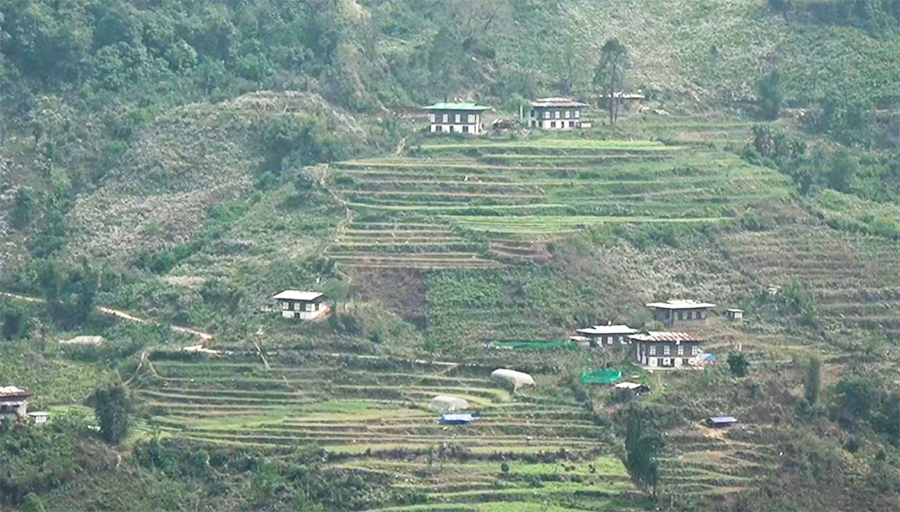
 What could be more confusing than having your census registered under one gewog but voting for the leaders of another? Well, in Chhukha, residents of Papaling village remain uncertain about whether they belong to Maedtekha Gewog or Dungna Gewog, as their census registration and polling stations fall under two different gewogs.
Reaching both Maedtekha and Dungna is already challenging. People usually travel either over a hundred kilometres from Phuentshogling or through Ganglakha below Gedu.
However, the route to Papaling takes a completely different direction. To reach the village, one has to travel along the Paro–Haa highway and then take a farm road from Bueltikha in Paro. Because of this, if villagers need to visit their gewog centre, they must travel more than 200 kilometres.
But distance is only part of the story. The village shares a unique administrative situation. Residents are registered in the census under Maedtekha Gewog. This means birth registrations, land ownership documents, and other official records are processed there. However, during local government elections, people vote for the leaders of Dungna Gewog.
According to the Election Commission, the village is placed as a separate chiwog with Babana of Dungna Gewog for electoral purposes. This mismatch has created confusion not only for residents but also for local leaders.
Villagers said they are often unsure which gewog they actually belong to. They also said that because of this administrative confusion, their villages have lagged behind in development activities.
“We pay the taxes in Maedtekha but vote in Dungna. Officials of Maedtekha come to our village for taxes and insurance. Our village is remote. And when we are in need of support, we don’t know if we should approach Maedtekha or Dungna Gewog,” said Chencho Dem, a resident.
“We are facing serious inconvenience because our census and sathram are all in Maedtekha gewog while we vote for Dungna local leaders. If we approach Dungna gewog in times of need, they cannot do anything because we fall under Maedtekha gewog and that way we are told to approach Maedtekha gewog. But we cannot ask Maedtekha gewog, as we voted for another gewog. We would be really grateful if this could be sorted out,” said Najay, another resident.
Maedtekha Gup raised the issue during the recent Dzongkhag Tshogdu. He said this has to change, as it is not convenient to work.
Maedtekha Gup Passang Tshering said, “Services today must follow strict systems and procedures, with many processes carried out online. As these systems become more stringent, the mismatch between census registration and electoral jurisdiction is creating serious inconveniences. For example, some residents are still unable to avail themselves of life insurance due to the administrative complexities.”
Meanwhile, election officials in Chhukha said the commission has been informed of the matter for consideration.
“As per our rules, we have to work on the delimitation every ten years to solve any underlying issues. The delimitation was first done in 2011, so we were supposed to review it in 2021. However, it could not be done because of the pandemic, so as per orders, we followed the old delimitation,” said NorbuWangdi, the district election officer.
Meanwhile, the village has received some developmental support from both the gewogs. However, residents say that rather than benefiting from the arrangement, they often miss out on opportunities, as each gewog assumes that the other will take the responsibility.
Until a clear decision is made, residents of Papaling continue to live between two administrative boundaries, belonging fully to neither.
Kinley Dem, Chhukha
Edited by Tandin Phuntsho