
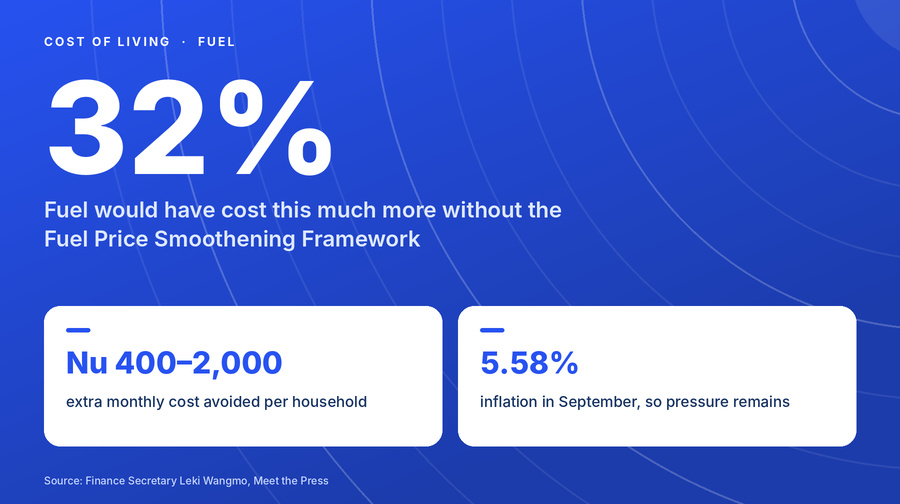
 To ease the rising cost of living, the government is subsidising fuel, providing electricity subsidies to rural households and extending assistance through various schemes. However, with inflation reaching 5.58 per cent in September this year, the pressure on household budgets remains. The government outlined its efforts during Meet the Press on Friday.
One of the measures is the National Fuel Price Smoothening Framework, introduced in March this year. Under the framework, the government absorbs part of the increase in international fuel prices, particularly diesel, to prevent the full increase from being passed on to consumers and businesses.
Finance Secretary Leki Wangmo said the intervention has helped prevent fuel prices from rising significantly.

“Our assessment by the Minister of Finance indicated that without the intervention of the National Fuel Price Smoothening Framework, fuel prices would have been approximately 32 per cent higher than what they are today in the market. And this could have a potential, a significant knock-on effect on transportation, food prices, and a wider cost of living.”
The Finance Secretary said the intervention is estimated to help households avoid additional monthly expenses ranging from Nu 400 to 2,000, depending on their fuel and transportation costs.
However, rising fuel prices are not the only concern. Bhutan’s heavy dependence on imports makes the country vulnerable to price increases in international markets. The weakening of the Indian Rupee against the US Dollar has also made imported goods more expensive.
Leki Wangmo said the depreciation of the Indian Rupee has affected the ngultrum, which is pegged to the Indian currency.
“In particular, the ngultrum, as all of us know, is pegged to the Indian rupee. And the depreciation of the Indian rupee over the years against the US dollar has translated into corresponding depreciation of our ngultrum. This depreciation has naturally resulted in the cost of importing our goods. And as you all know, Bhutan is a highly import-dependent country. Therefore, we are highly exposed to external price shocks through both international commodity prices as well as exchange rate movements.”
Other government measures include subsidised electricity for rural households, student meal allowances in schools, agricultural subsidies and the Price Guarantee Scheme under the Economic Stimulus Programme.
The revised income tax system is also expected to provide relief to eligible taxpayers.
However, the Finance Secretary said subsidies and price interventions alone cannot provide a long-term solution, as they also have financial implications for the government.
She said the government’s long-term focus is on strengthening domestic production, improving agricultural productivity, reducing imports and creating more employment opportunities through private sector development.
Tashi Dekar
Edited by Sonam Pem