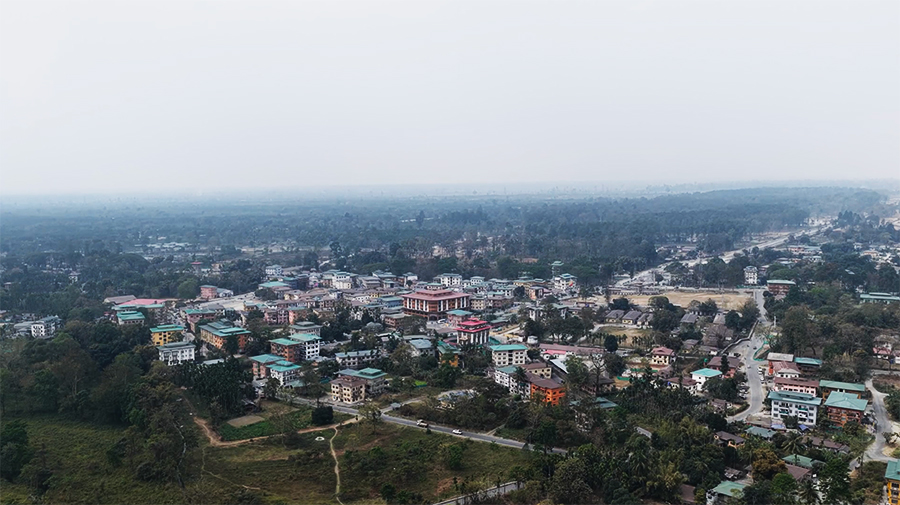
 Gelephu Mindfulness City is growing, and so is the need for somewhere to live. The city is now planning a 256-unit housing project as more people arrive for work, business and other opportunities, while families are also being relocated for development. The housing project is expected to be completed by June next year.
As GMC takes shape, more people are coming into the city for work, business and other opportunities. With several major projects already underway and more planned, finding a place to live is becoming a growing concern for many residents and workers.
For some, the challenge is not just finding a house, but finding one that is available, affordable and close to where they work.
“We are facing a severe housing shortage in Gelephu, and rents have also increased significantly. A house that used to cost around Nu 8,000 now costs between Nu 14,000 and Nu 15,000. Even for small apartments, landlords are asking for around Nu 12,000 to Nu 13,000 in rent,” said Sangay Wangdi, a resident of Gelephu.
“We have heard of building owners increasing rents in different parts of Gelephu. At the same time, construction of new buildings has been put on hold in some areas. It would be helpful if people were allowed to build smaller houses, or if the government could provide housing, to help address the growing shortage in Gelephu,” said Chatur Singh Tamang, another resident of Gelephu.
“Compared to previous years, finding a house in Gelephu has become very challenging. With the increasing number of people coming to Gelephu, competition for housing has also increased, especially for houses located nearby,” said Som Nath Koirala, also a resident of Gelephu.
To address part of this demand, the Gelephu Mindfulness City Authority has issued a Request for Proposal, RFP, for the design, construction and operation of a 256-unit housing project.
The project will be developed on about 13.7 acres of land and will comprise different types of accommodation. There will be 100 two-bedroom units, 100 three-bedroom units and 56 co-living units.
According to the RFP, the development is intended to provide more than just residential buildings. It will include children’s play areas, landscaped open spaces, internal roads and footpaths, parking, security facilities, waste-management infrastructure, and other basic services.
The project will also include provision for commercial space, allowing for neighbourhood services such as convenience stores, cafés, a crèche, a pharmacy and other businesses.
The housing project will follow a Design-Build-Operate model. Under this arrangement, the selected developer will be responsible for designing, financing and constructing the project, and will also operate and maintain the housing complex after completion. The developer is expected to operate the project for 30 years under the concession arrangement.
According to the RFP, relocated families will have priority for occupancy. For the first ten years of operation, the Authority will also guarantee occupancy equivalent to 70 per cent of the residential units, or 179 units. However, the rental rates have yet to be fixed.
The project is on a tight timeline. Construction is scheduled to begin in December this year, with all 256 units expected to be completed and commissioned by June next year, according to the RFP.
For GMC, the project is part of the planned housing response as the city develops and families are relocated to make way for major projects. The next step now is to select a developer who will take the project from design and construction to long-term operation.
Passang Dorji/Karma Wangdi, Gelephu