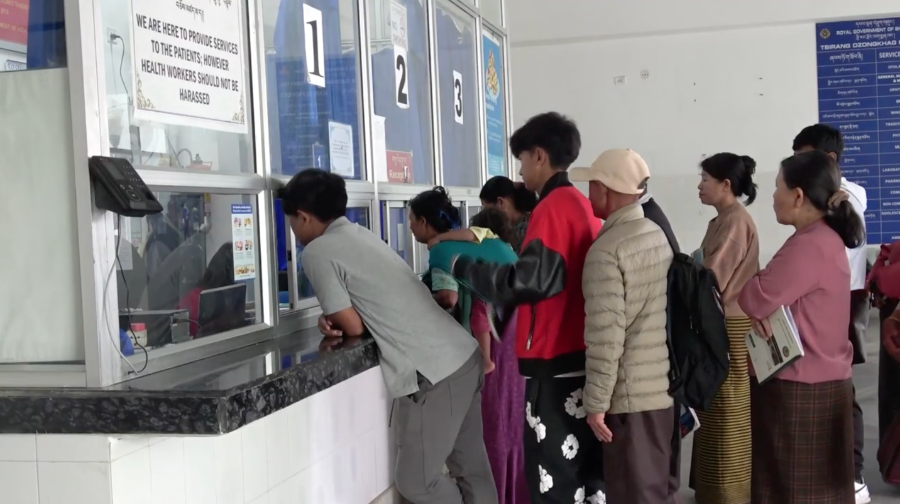
 Seeking a medical appointment at Damphu Hospital in Tsirang is becoming not only difficult but also costly for some patients. Many return home without seeing a doctor after failing to secure consultation tokens, forcing them to make the journey again, while others have to stay overnight in town. Local leaders say the token system is delaying access to healthcare, but the hospital says the real challenge is a shortage of doctors. The issue was discussed during the recent Tsirang Dzongkhag Tshogdu.
Some patients arrive at Damphu Hospital before even the hospital opens, hoping to see a doctor.
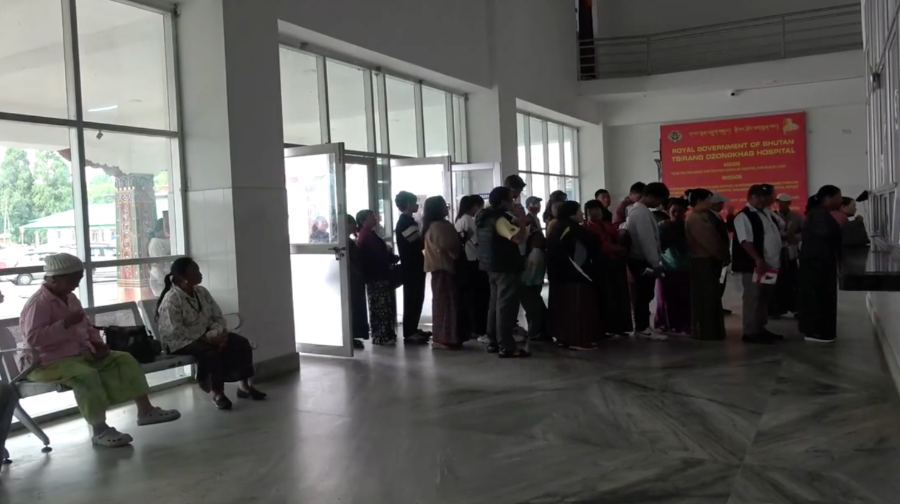 Registration starts around 9 AM, and on busy days, consultation tokens are often exhausted by around 11 AM. Their journey ends without treatment, forcing them to return home or spend another night in town.
The 40-bed Damphu hospital serves residents of 12 gewogs in Tsirang as well as people from neighbouring gewogs in Dagana.
At the recent Dzongkhag Tshogdu, local leaders said patients travelling from distant gewogs for treatment are facing additional financial and logistical burdens, especially when they are unable to see a doctor on the same day.
Kilkhorthang Mangmi Sonam Lhamo said, “Some patients have to return home without getting healthcare services when they don’t get tokens. This affects their access to timely healthcare. We would be grateful if the hospital could discontinue the token limit.”
“It would be more convenient if unused tokens can be carried over to the following day. Patients from distant gewogs like Barshong and Sergithang have to stay overnight in Damphu to seek treatment. Those who travel from the gewogs on the same day usually fail to get tokens or have to wait until the end of the queue. But many end up returning home, unable to secure tokens,” said Sergithang Gup Phub Dorji.
Pungtenchhu Gup Shiva Lal Karaiya said, “The problem should be addressed before it becomes more serious. The government should consider deploying additional doctors or explore other measures to ease the burden on patients and resolve unnecessary inconveniences.”
Mendrelgang Mangmi Tshering said, “The problem could worsen if patients continue facing the same problem. We would be grateful if the hospital could consider issuing tokens till noon and the same patients are treated on the same day.”
Meanwhile the Chief Medical Officer said the hospital is facing a shortage of doctors rather than a problem with the token system itself.
The hospital currently has three general doctors after one doctor recently left for further studies. However, on days when doctors attend official meetings or public programmes, only two doctors remain available to see patients.
According to the hospital, each doctor sees at least 70 patients a day and sometimes more than 100, excluding follow-up consultations and prescription refills.
On average, nearly 190 patients visit the hospital every day.
“Simply registering all patients without the capacity to attend to all of them on the same day is of no use. This would create another problem. It would not be practical to solve one problem by creating another. The token system is not to restrict patients from accessing medical care,” said Dr Tshering Penjor, the Chief Medical Officer of the Damphu Hospital.
He says it has already begun introducing measures to reduce pressure on doctors.
“Patients on regular follow-up medication are now encouraged to undergo blood tests after obtaining a token quota. They are asked to register only for the review. Another initiative will be introduced soon which will allow patients with blood pressure and diabetes to first consult the hospital’s NCD focal person. They will be referred to doctors only if their test results require further medical attention.”
The Dzongkhag Tshogdu decided to write to the Ministry of Health requesting an additional doctor to replace the one who left for further studies.
The shortage at Damphu Hospital comes even as Bhutan continues to increase its medical workforce. According to the Health Ministry’s Annual Health Bulletin 2025, the number of doctors has grown from 336 in 2020 to 411 in 2024.
Despite this progress, staffing gaps remain in some health facilities, highlighting the challenge of ensuring doctors are available where they are needed most.
Meanwhile, the ministry is also expanding services such as telemedicine and mobile medical units to bring healthcare closer to people, especially those in remote areas.
For now, patients can only hope that these measures, along with the hospital’s ongoing initiatives, will reduce the burden on patients and improve access to timely healthcare services.
Pema Tshewang, Tsirang
Edited by Sangay Chezom