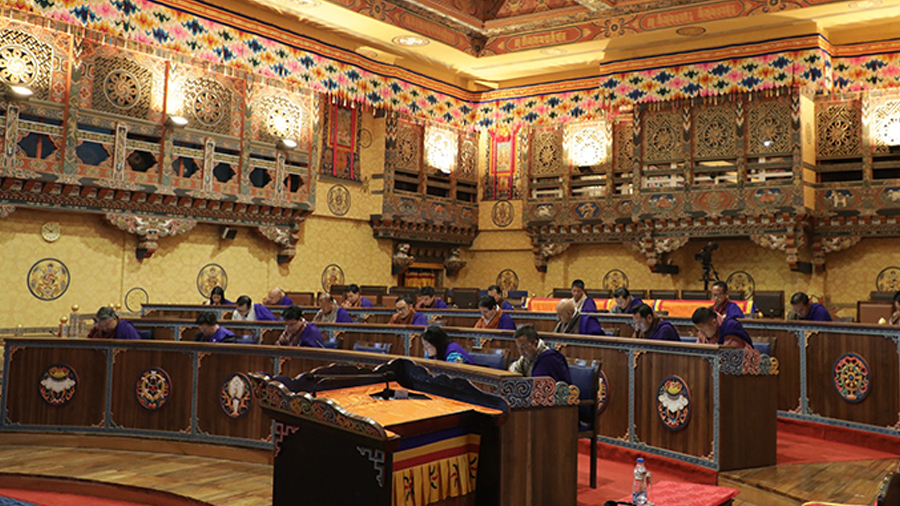
 As the National Council deliberated on the Convention on the Rights of Persons with Disabilities, the Social and Cultural Affairs Committee of the House proposed to replace the term reservations with declarations. The National Assembly adopted the convention with three reservations last session and then forwarded it to the National Council.
Bhutan ratified the Convention on the Rights of Persons with Disabilities during the previous government term with four reservations. These reservations were submitted to the United Nations in 2024.
Subsequently, eleven countries objected to the reservations made by Bhutan.
Following that, the National Assembly revised its stance on the Convention on the Rights of Persons with Disabilities by amending three reservations and fully withdrawing one during the last session.
The three reservations include liberty of movement and nationality, work and employment and participation in political and public life.
However, in the National Council, as the Social and Cultural Affairs Committee recommended to change the term reservations to declarations, MPs raised concerns that reservations and declarations are not the same and should be clearly distinguished.
“It is not about changing the laws and policies of our country. The UNCRPD is an international convention, not a national law. If we accept all its provisions without reservations, it may require us to follow international obligations that may not fully align with our domestic laws. So, what is the reason for changing it to a declaration?” questioned Sonam Tobgyel, MP, Trashigang, NC.
“We need to clearly understand the difference between a reservation and a declaration. In 2024, it was adopted as a reservation, meaning we would not comply with certain provisions. A declaration suggests that while our laws may differ, we still agree in principle. If we examine this carefully, it could raise concerns regarding the Constitution and the sovereignty of the country,” said Tshering Wangchen, MP, Monggar, NC.
“The Vienna Convention on the Law of Treaties allows countries to make reservations. However, if a reservation defeats the purpose of the Convention, it may not be permitted. In this case, we have already examined the matter and completed the groundwork. Therefore, any move to withdraw or change reservations should be carefully considered,” said Ugyen Tshering, Eminent Member, NC.
“During the last session, the committee presented these reservations after thorough research, stating that certain provisions did not align with our national laws. We accepted them as reservations. These reservations do not harm persons with disabilities, as Bhutan already has policies and legal frameworks to support them. Therefore, the committee should clearly explain the need to change them to declarations,” said Jamyang Namgyal (PhD), MP, Pema Gatshel, NC.
The committee clarified that the shift from blanket reservations to declarations is intended to better align with international human rights standards.
“From the committee’s perspective, replacing reservations with declarations is not an issue. The initial reservations submitted to the United Nations were broad and lacked strong justification. The term ‘reservation’ itself can be restrictive, which is why we proposed changing it to a declaration,” said Phub Dorji, Chairperson, Social and Cultural Affairs Committee, NC.
“Before presenting the UNCRPD to Parliament, a national interest analysis was conducted. It clearly stated the reasons for initially adopting reservations. It also emphasised that implementation would be carried out in line with national laws and regulations. These reservations have not harmed persons with disabilities. However, we believe that the amendment will further strengthen their rights and accessibility,” said Pema Tashi, Member, Social and Cultural Affairs Committee, NC.
The convention, along with the committee’s final recommendations, is scheduled for adoption next week.
Sonam Yuden
Edited by Tshering Zam