
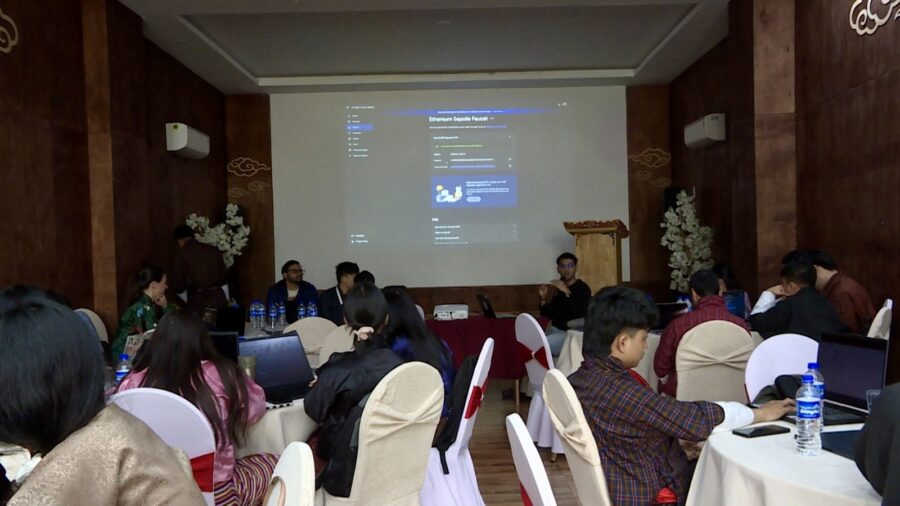
 As the country accelerates its digital transformation efforts, Bhutanese students, software developers, and business professionals are exploring how blockchain technology could help solve longstanding public service challenges. Guided by both international and local experts, participants are taking part in a programme aimed at developing practical digital solutions tailored to Bhutan’s governance needs.
Officials from the GovTech Agency identified some current challenges such as legal age verification for alcohol sale, tampered documents and signatures, to lengthy procurement procedures and academic credentials verification.
Participants will now be finding solutions to such kind of challenges.
Additionally, they may come up with their own innovative ideas which uses blockchain to improve public service delivery.
Tshering Yangden, a student from GCIT said, “While exchanging currencies, services are slow. Moreover, it is not very secure. If blockchain technology is used, we can tackle all those challenges.”
Dorji Pema, another student from GCIT said, “As academic certificates are necessary these days, there are cases that some produce fake certificates. Using blockchain, our team aim to develop a secure solution to tackle that issue.”
Likewise, Phurpa Dorji, also a student said, “In Bhutan different agencies do not share data smoothly, meaning that many government agencies’ services require more than one approval from more than one agency. So, with a blockchain based solution like a trusted inter agency data exchange, we can create a shared trust layer where each agency can verify that another agency has issued a valid credential or approval.”
Organisers say the programme is aimed at helping young innovators build practical digital solutions relevant to Bhutan’s needs.
Jamyang Sonam, Chief Programme Officer of GovTech Agency said, “We started this programme with support from the Ethereum Foundation. Through this, the aim is to develop blockchain skills and drive innovation to improve service delivery. We would explore the current challenges and inconveniences. Then after the discussion among the experts and participants, we would come up with solutions.”
Participants also learned about Bhutan’s blockchain strategy and how the National Digital Identity can support future digital services.
Kim Buisson, Expert/Chief Operation Officer of Funding the Commons said, “Many of the current systems arep still quite manual or require data to be transferred from different agencies. This idea is to build on top of the current NDI system so that we already have a layer of efficiency and then to create new products on top of it. This will allow us to have more verification, more accuracy and for the data to also live in perpetuity, so there’s always a reference of what took place. It can also limit corruption or limit human error, which is great.”
The four-day bootcamp will continue with technical sessions and team-building activities and a hackathon will follow later this week.
Teams with the best ideas to address current challenges in public service delivery will receive support and be awarded.
Kelzang Chhophyel