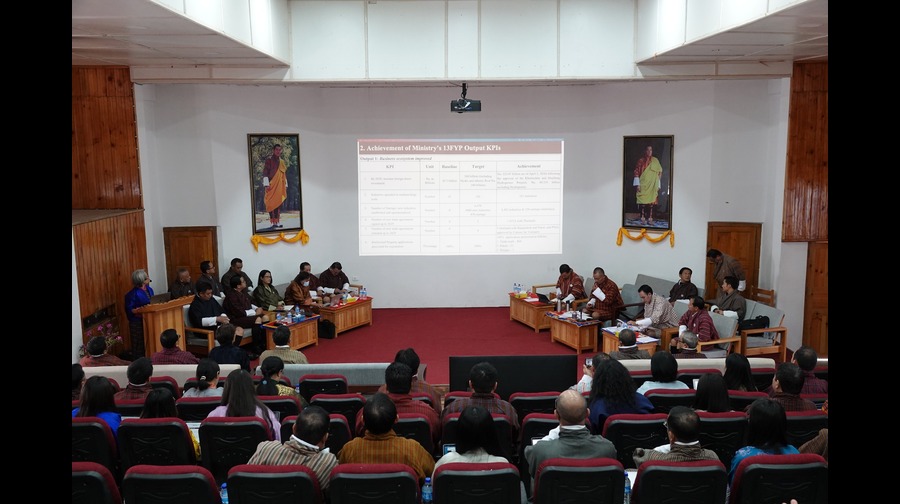
 Efforts to identify and remove regulatory processes that hinder the country’s business environment are moving forward. The review of 210 such issues is now complete while for another 955, the work is ongoing. The Ministry of Industry, Commerce, and Employment is leading the government’s effort to identify and clear regulatory bottlenecks.
At the Mid-Term Review, the ministry reported that 210 business regulatory issues were reviewed initially. Of them, more than half were resolved last year and the remaining were pursued with relevant agencies and reviewed recently. As per the ministry, 26 of the overall reviewed issues had legislative and overall policy implications. They have been submitted to the Cabinet for further directives or intervention.
The review team also found five issues deemed insignificant and two that could not be considered.
Tashi Wangmo, MoICE Secretary said, “This responsibility was assigned to our ministry. We immediately reached out to the Bhutan Chamber of Commerce and Industry and other private sector representatives to identify rules, Acts, and regulations that hinder the ease of doing business. We received more than 200 such regulatory barriers. We then worked closely with relevant ministries and agencies to review these concerns, understand the challenges, and systematically categorise the issues.”
The initial review highlighted the scale of regulations business have been navigating before the reform. Accordingly, the government initiated a comprehensive review of the regulatory instruments affecting the ease of doing business.
Last year, in collaboration with different ministries, agencies and Local Governments, another 955 business regulatory instruments – including policies, Acts, rules and regulations, guidelines and Standard Operating Procedures, executive orders, notifications, and internal mechanisms, were identified for evaluation.
Prime Minister Tshering Tobgay said, “The number seems huge to me. Navigating all of them is going to be really difficult. They must be reviewed properly. If they are important, we will have to keep them and ensure to implement them efficiently. If they are not important and hindering progress, we must remove them.”
These regulatory instruments are under review in close consultation with the private sector through the Bhutan Chamber of Commerce and Industry. During the assessment, if the concerned ministries and agencies fail to justify the need for such instruments, the review team will propose for their deregulation. The process is expected to be complete towards the later part of this year.
The systemic effort to identify and resolve business regulatory processes impeding the country’s business environment was one of the 13 pledges that the government took during their first day in office.
Samten Dolkar