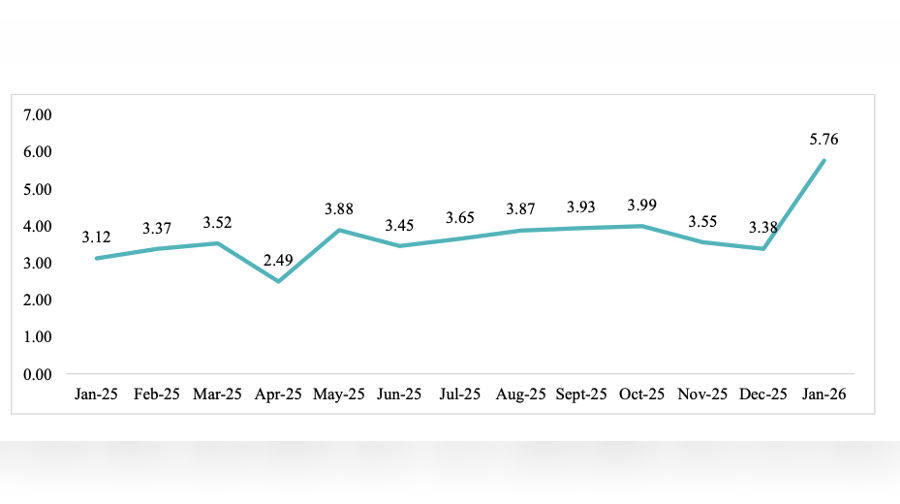
While your monthly income may remain steady, what that money can actually buy is diminishing. According to the National Statistics Bureau, the national inflation rate has reached 5.76 per cent, meaning that, on average, goods and services are 5.76 per cent more expensive than they were in January last year. This increase is driven by higher prices for both food and non-food items tracked under the Consumer Price Index.
The National Statistics Bureau reports that inflation stood at 3.12 per cent in January last year and remained between 3 and 4 per cent through December. However, last month it rose sharply to 5.76 per cent.
Both food and non-food prices drove the increase. Food inflation reached 3.48 per cent in January. A sharp rise in alcohol and betel nut prices pushed food inflation higher, even though most regular food items increased by around 2 per cent.
Non-food inflation also rose to 3.51 per cent, despite a 2.20 per cent drop in transport costs. Higher prices for housing and utilities, restaurants and hotels, and health services largely fuelled the increase.
Inflation varies across the country. The Central region recorded the highest rate at 7.86 per cent, while the capital followed at 7.10 per cent.
Over the past year, the purchasing power of the Ngultrum has declined by 3.26 per cent. One hundred Ngultrum today is worth only 51.8 Ngultrum compared with what it could buy in 2012. In simple terms, consumers now receive just over half the value for the same amount of money.
Although the cost of living has risen, economists say inflation remains manageable and has not reached a level that would disrupt the economy or require intervention from the Government or the Central Bank.
Bhutan’s highest recorded inflation rate was 13.53 per cent in June 2012.
Kinley Bidha
Edited by Sangay Chezom