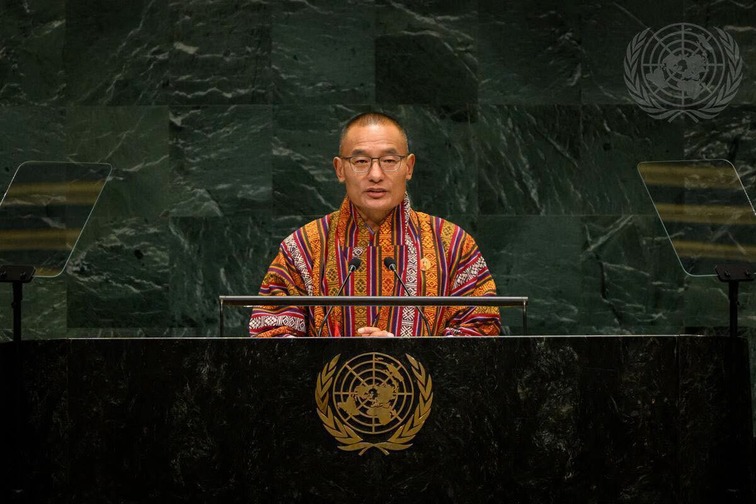
 Bhutan turned its presence into opportunities at the United Nations, calling for stronger global partnerships. Addressing the General Debate of the 81st United Nations General Assembly in New York yesterday, Prime Minister Tshering Tobgay invited investors and world leaders to join Bhutan in building the Gelephu Mindfulness City, a project envisioned to drive economic growth while promoting sustainability.
The Prime Minister described his role at the General Debate as a ‘salesman’ rather than a Head of Government. Prime Minister said he wasn’t there to sell a policy or negotiate a declaration, but to sell an idea conceived and spearheaded by His Majesty The King, an idea that is already taking shape as the Gelephu Mindfulness City.
“To governments and institutions seeking partnership, and to investors, entrepreneurs, and companies seeking the next great opportunity, do not watch GMC being built. Come to Bhutan. Come to GMC. Help define the journey. Build it with us. Become our co-founders because the future does not simply arrive. The future is built. And in Bhutan, we are already building it.”
The Prime Minister highlighted GMC’s strategic location, access to regional markets, clean renewable energy and potential in emerging sectors including artificial intelligence, advanced manufacturing and data centres.
But he said Bhutan offers something money cannot buy: trust, built on peace, political stability, rule of law and a record of honouring its commitments.
“For long-term investors, trust creates something invaluable: predictability. Bhutan has built generations building that trust. GMC puts it to work. Then there is nature. Imagine GMC in the morning, mist rising from its rivers, forest stretching towards the mountains, elephants moving through the landscape, tigers still roaming its forest. This is not empty land; it is a living, carbon-negative landscape, a biodiversity hotspot that we will build over it. We will build within it and protect it. The forest, rivers and wildlife of GMC are not obstacles to development; they are part of its value.”
On the sidelines, the Prime Minister held a series of meetings with leaders, international organisations and businesses to advance areas of mutual interest.
He met the Prime Minister of Bangladesh and the President of Vietnam, while discussions with other partners focused on investment, development, climate action and bilateral cooperation.
With David and Lucile Packard Foundation and Qubit by Qubit, he discussed investment opportunities in agricultural sustainability and green finance, including efforts to make Bhutan’s agriculture sector more investable.
The World Bank Group’s Executive Director for Bangladesh, Bhutan, India, and Sri Lanka also called on the Prime Minister. They discussed ways to deepen cooperation in support of the country’s development priorities.
The Prime Minister also met the Administrator of the United Nations Development Programme (UNDP) and Executive Director of the Green Climate Fund (GCF). The meetings focussed on strengthening development and climate cooperation, including support for climate adaptation and early warning systems.
Nepal’s Foreign Affairs Minister and Maldives’ Foreign Minister also called on the Prime Minister. Discussions covered bilateral relations and cooperation in areas including trade, aviation, climate change, health, tourism and agriculture.
The Prime Minister is leading the Bhutanese delegation comprising senior officials from the Prime Minister’s Office and the Ministry of Foreign Affairs and External Trade until the 28th of this month.
During the High-Level Week, the Prime Minister will also host the High-Level Meeting of G-Zero Forum States, an international coalition of carbon-negative and carbon-neutral countries, in partnership with UNDP.
Kelzang Chhophyel
Edited by Sonam Pem